
Why Your Radiation Detector Gives Different Readings
Your Geiger counter reads 25 CPM one minute and 60 the next, in the same spot. Learn why CPM, background and energy response shift readings — and what to do.
The short answer
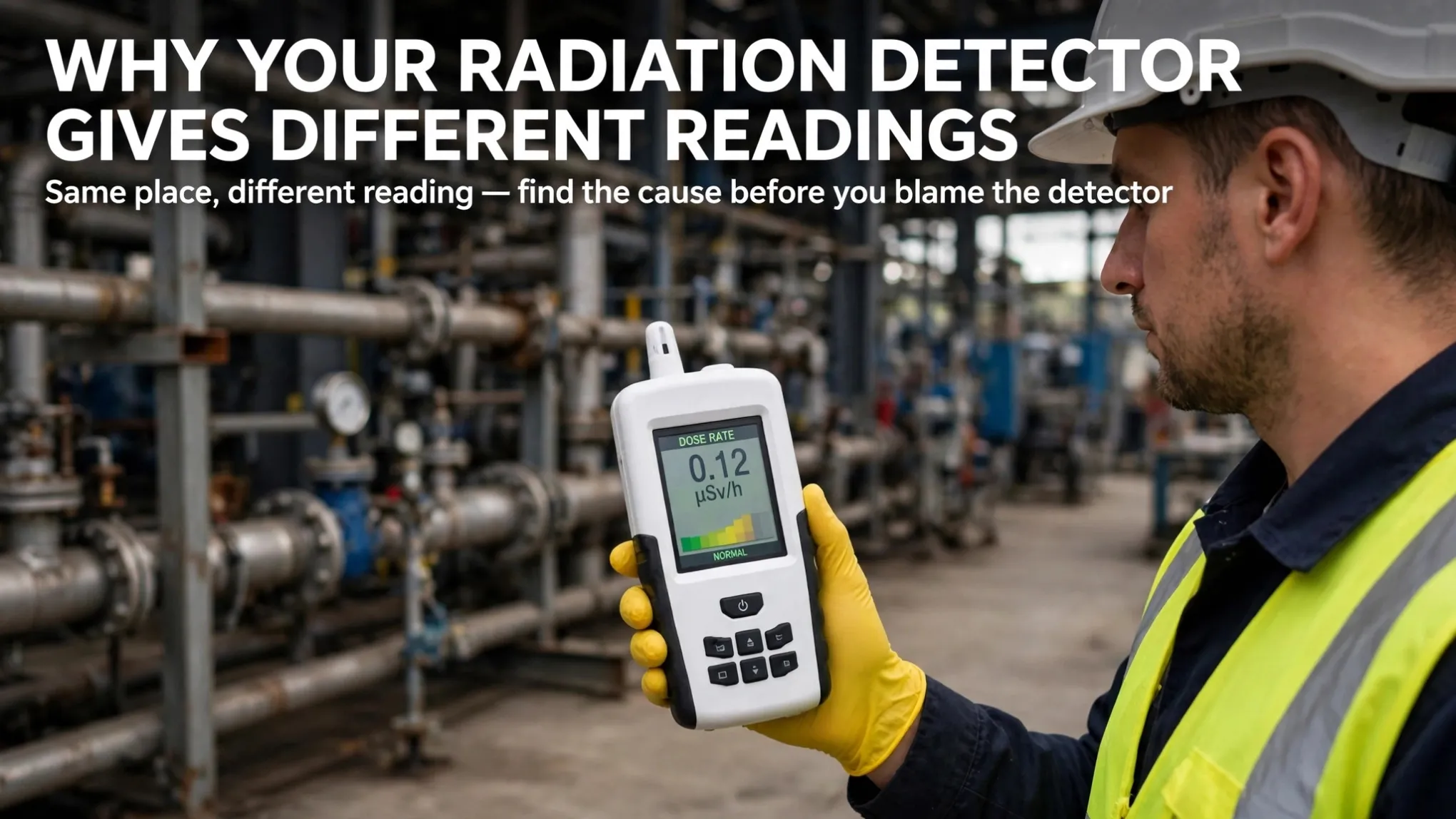
In most cases, your detector is not broken. A handheld radiation detector gives different readings in the same place because it counts random events, not a steady flow; because the background radiation around you actually changes during the day; and because CPM and µSv/h are two different things that are easy to confuse. Before you return the instrument, check five things: the unit on the display, the counting time, the background baseline, the distance and position, and the energy response of the tube.
1. CPM is not dose — and two detectors will never agree on CPM
CPM (counts per minute) is simply the number of radiation events the tube registers in one minute. µSv/h (microsieverts per hour) is an estimated dose rate, calculated from those counts using a conversion factor that belongs to one specific tube.
Two Geiger counters placed next to the same source will almost always show different CPM values — and both can be right. A small tube might register 20 CPM where a large pancake tube registers 130 CPM at the exact same dose rate of 0.1 µSv/h, because the larger tube simply catches more events. The radmon.org community explains it with a simple image: two buckets in the same rain. The wide bucket collects more drops than the narrow one, but the rainfall is identical. The tube is the bucket.
So never compare CPM numbers between models. Compare µSv/h — and only if both instruments were calibrated against the same reference source, usually caesium-137, with a conversion factor matched to their own tube.
2. Radioactive decay is random, so short readings always swing
Atoms decay at random intervals, governed by Poisson statistics. Even in a perfectly stable field, with the detector held still, the count in any short window bounces around.
At a typical background of around 30 CPM, a 10-second display window expects about five counts — but it may show two, or eight, purely by chance. The display converts that short count into a rate, so the reading can swing from 12 to 48 CPM in seconds. Nothing changed in the room.
Let the detector average over at least one full minute, and for a background baseline, over 10 to 15 minutes. Take three 60-second readings in the same spot and average them. If the three averages agree within roughly 10 percent, the detector is behaving normally. If a single one-second snapshot worries you, you are reading noise, not radiation.
3. The background itself moves during the day
Natural background comes from cosmic rays, from radon gas and its decay products in soil and building materials, and from naturally radioactive minerals such as potassium-40 in granite and some ceramics. All three vary during the day.
Rain can wash radon decay products out of the air, producing a temporary spike known as radon washout. A closed room lets radon accumulate; opening a window can bring the reading back down. Moving the detector from a wooden table to a granite worktop, or from the ground floor to a basement, changes the background too.
That is why a baseline matters more than any single number. Before measuring anything, run the detector in the same room, in the same position, for 10 to 15 minutes and record the average. Then measure your sample and subtract the baseline — the net CPM is the figure that means something.
4. Energy response: the same dose can read three times higher
Geiger-Müller tubes are calibrated against one reference energy, usually the 662 keV gamma rays of caesium-137. Real radiation comes at many energies, and a bare GM tube does not respond evenly to all of them. At low photon energies, many tubes over-respond dramatically — budget models can inflate the reading by 300 percent or more for low-energy gamma. At very high energies they can under-respond.
An energy-compensated GM tube uses a filter that flattens the response across the energy range, so the dose-rate reading stays closer to the truth whatever the source. The catalogue models Zhanyueda supplies in this category — the KT002 and the TC-8500 — both use an energy-compensated GM tube covering 20 keV to 3.0 MeV, with a stated energy response within ±30 percent of the caesium-137 reference. A detector with no stated energy response leaves you guessing.
5. Position, distance and shielding change the reading fast
Radiation from a point source falls off with the square of the distance. Move the detector from 10 cm to 20 cm away and the count rate drops to roughly a quarter. A few centimetres of difference in hand position, a detector turned so the tube window faces away from the source, or a metal case between the source and the tube can each change the reading substantially.
For repeatable results, fix the position — same surface, same distance, same orientation. When comparing two instruments, place them side by side, not one after another in a hand that keeps moving.
6. When it really is the instrument
After the checks above, a few genuine faults remain. A low battery is the most common: several user reports describe erratic readings and drifting zero on a failing battery. A damaged or ageing GM tube can lose sensitivity or become noisy. A wrong conversion factor — set for a different tube than the one fitted — makes every µSv/h reading wrong by a fixed ratio. And at very high radiation fields, a GM tube saturates: its dead time means it cannot count fast enough, so the reading plateaus or even falls while the real dose rate keeps rising. That last failure is the dangerous one, because the instrument looks calm while the field is not.
If a detector fails the three-reading average test, or gives the same reading no matter what you point it at, stop trusting it and have it checked or calibrated.
A five-minute check before you blame the meter
- Confirm the unit on the display — CPM or µSv/h — and compare like with like.
- Let it count for a full minute, three times, and average the results.
- Measure a baseline in the same room and subtract it before judging a sample.
- Hold the detector still, at a fixed distance and orientation, away from stone, ceramics and electronics.
- Check the battery, and confirm the tube type and conversion factor match the manual.
What to ask before you buy
For importers and distributors, the buying lesson is straightforward. Ask for the tube type and whether it is energy-compensated, and over what energy range. Ask for the sensitivity figure in CPM per µSv/h, so you can judge whether the instrument can see the levels your customers need to measure. Ask whether a calibration certificate against a known source is included, and how often recalibration is recommended. Ask for both a real-time dose rate and a cumulative dose display — the TC-8500, for example, shows 0–99.99 µSv/h in real time and the same range for cumulative dose, with 0.01 µSv/h resolution — because a survey meter that only shows an instant rate cannot record total exposure.
If your team needs a radiation detector with an energy-compensated GM tube, a clear dose-rate and cumulative display, or OEM branding for your own label, contact us at zydhardware.com — tell us the dose range and application, and we will confirm the right model for you.