
Why Your Socket Tester Says "Correct" on a Faulty Outlet
Your socket tester says "correct" — but the outlet may still be dangerous. Here are five faults a plug-in tester cannot see, and how to check for them.
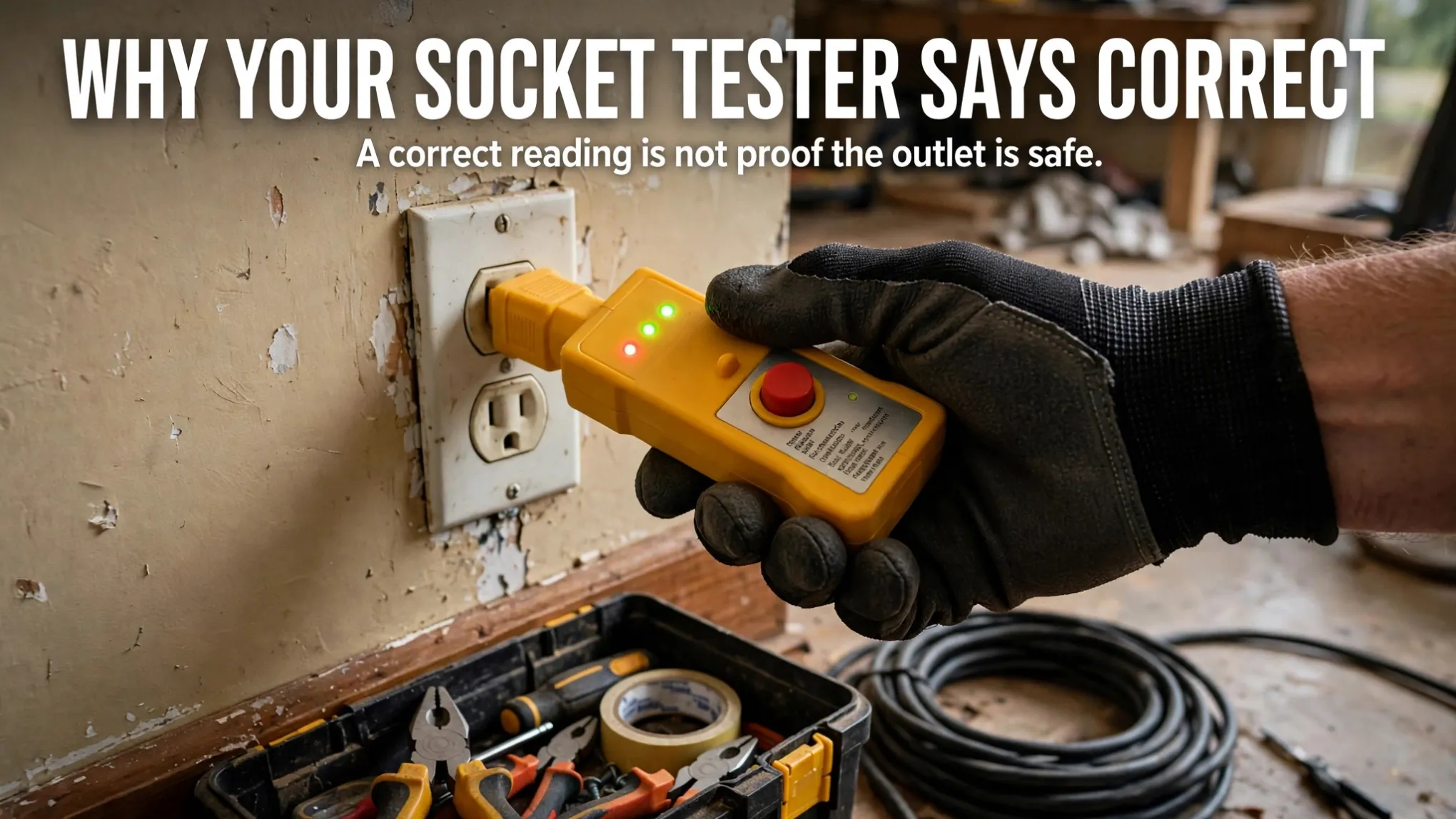
A plug-in socket tester is one of the fastest tools an electrician owns: read the lights, and in three seconds you know whether the wiring looks right. The trouble starts when the lights say "correct" and the outlet is still faulty. That reading is real, but it answers a much narrower question than most people think. A three-light tester only checks whether voltage appears where expected. It cannot prove the ground is real, the connections can carry current, or catch faults that only show up under load.
What a Three-Light Socket Tester Actually Checks
Inside a basic socket tester are three lamps wired between the three slots of the outlet: hot to neutral, hot to ground, and neutral to ground. The pattern of lit lamps is matched against a legend on the tester body, naming faults such as open ground or reversed polarity. That is the whole test. It draws only a few milliamps, so it checks continuity and polarity at essentially no load. It does not measure how much current the circuit can carry, how good the ground path is, or whether the wires behind the outlet are sound. Treat it as a fast screen for gross wiring errors, not as a certificate that the installation is safe. Proper verification still needs calibrated installation test equipment and a qualified person.
The Bootleg Ground: The Fault That Reads "Correct"
The most dangerous fault a socket tester cannot see is the bootleg ground. On an old two-wire circuit with no equipment ground, someone installs a modern three-prong outlet and the tester reports "open ground". Instead of running a real ground wire, they add a short jumper between the neutral and ground terminals inside the outlet box. The tester now reads "correct": the ground pin is electrically connected to neutral at that outlet. Nothing about the circuit changed. Only the reading did.
A bootleg ground is dangerous precisely because it hides. In normal operation it puts ordinary return current on the ground pin, so every metal-cased appliance plugged in carries current on its chassis. The serious failure comes if the neutral ever opens upstream — a loose terminal, a failed connection along the run. With the neutral broken, conductors downstream of the break are no longer at ground potential, and the jumper puts that voltage onto the ground pin and the metal case of everything plugged in.
An open ground, by contrast, is an honest limitation: you can see the two-prong outlets and know the protection is missing. A bootleg ground is an unknown limitation that actively creates new failure modes, which is why wiring codes do not accept it as a fix. The US National Electrical Code allows only three remedies: run a real grounding conductor, install a GFCI marked "No Equipment Ground", or put a two-prong receptacle back. Jumping ground to neutral is not a fourth option.
Four More Faults a Plug-In Tester Cannot See
Loose or high-resistance connections. A backstabbed connection with only two strands of copper left will still read a flawless 121 volts on a meter, because a meter draws microamps. Under a 12.5-amp load it drops several volts, warms up, and eventually fails. A tester that draws almost no current cannot find this fault. Only a load test can.
A high-resistance ground. The ground wire may be connected but corroded, undersized, or terminated badly, so its resistance is far too high for a protective device to trip quickly. A simple tester sees continuity and reports "correct"; it cannot measure earth loop impedance. Advanced testers display loop impedance; a reading above a few ohms warns the protection may not react fast enough.
Neutral and ground swapped upstream. Because neutral and ground are bonded together at the main service panel, they are hard to tell apart from the outlet alone. A swap upstream can read as correct on a plug-in tester, and even a multimeter struggles to separate them. The BENNING SDT 1 manual warns about this fault by name: it cannot detect an inversion of neutral and protective earth.
Reversed supply polarity. A tester can catch a hot-neutral swap at the outlet itself, but not a polarity reversal further upstream in the supply. Some specialised testers add a touchpad check for this; a basic three-light tester does not.
How to Check Beyond the Tester
When a "correct" reading does not match the building — an old two-wire house, a room of new three-prong outlets — run three more checks before you trust it.
1. Measure with a multimeter. Read the three combinations at the outlet face with a True RMS multimeter: hot to neutral, hot to ground, and neutral to ground. On a 120-volt system, hot to neutral and hot to ground should both read close to line voltage, and neutral to ground should read near zero — no more than a volt or two under normal load. (On 230-volt systems, use the local nominal voltage.) A neutral-to-ground reading of exactly zero, especially under load, is suspicious rather than reassuring: it is what you see when neutral and ground are bonded directly together at the outlet. A multimeter alone cannot prove a bootleg ground either; it only adds evidence.
2. Load-test the outlet. Plug in a 1,500-watt heater or a hair dryer on high and re-read the voltage at the same outlet. A healthy circuit holds its voltage. A big drop under load means a loose or high-resistance connection somewhere, even though the tester said "correct".
3. Compare with a known-good ground. Measure between the outlet's ground pin and a verified ground on a different circuit, such as a cold-water pipe or a grounded outlet elsewhere. A properly grounded outlet shows essentially no voltage to a true ground; a bootleg shows a small voltage that rises under load. If the building is old two-wire throughout and every outlet reads "correct", suspect a jumper behind the faceplate — and leave that to a qualified electrician.
What to Ask Before You Buy or Stock Socket Testers
For distributors and own-brand buyers, the question is not "does it light up" but "what can it actually see". A basic three-light tester is a legitimate screening tool for pre-handover checks and site surveys. For work where the answer matters — rental inspections, renovation sign-off — look for a tester that also shows earth loop impedance or checks incoming-supply polarity. The GFCI/RCD trip button is worth paying for: confirming the protective device actually operates beats another wiring indication. In the 2025 Zhanyueda catalogue, the SK310 plug-in tester covers up to six wiring errors with an LED display and includes a push-button GFCI integrity test; check the voltage version against your market — the catalogue model is rated 110–125 V. Ask your supplier which versions exist for 230-volt markets and whether the legend comes in your customers' languages.
The Rule to Remember
A "correct" reading means no detectable wiring fault was found at no load. It does not mean the ground is real, the connections are sound, or the circuit is safe. Treat the green lights as the start of the check, not the end of it — and when the building's history says the wiring predates modern grounding, trust the history over the lights.
If you stock or specify socket testers, multimeters, or installation test equipment for electricians and inspectors,visit zydhardware.com to discuss your requirements, OEM/ODM options, and sample evaluation.