
Buying Guides
Why Your Sound Level Meter Gives Different Readings
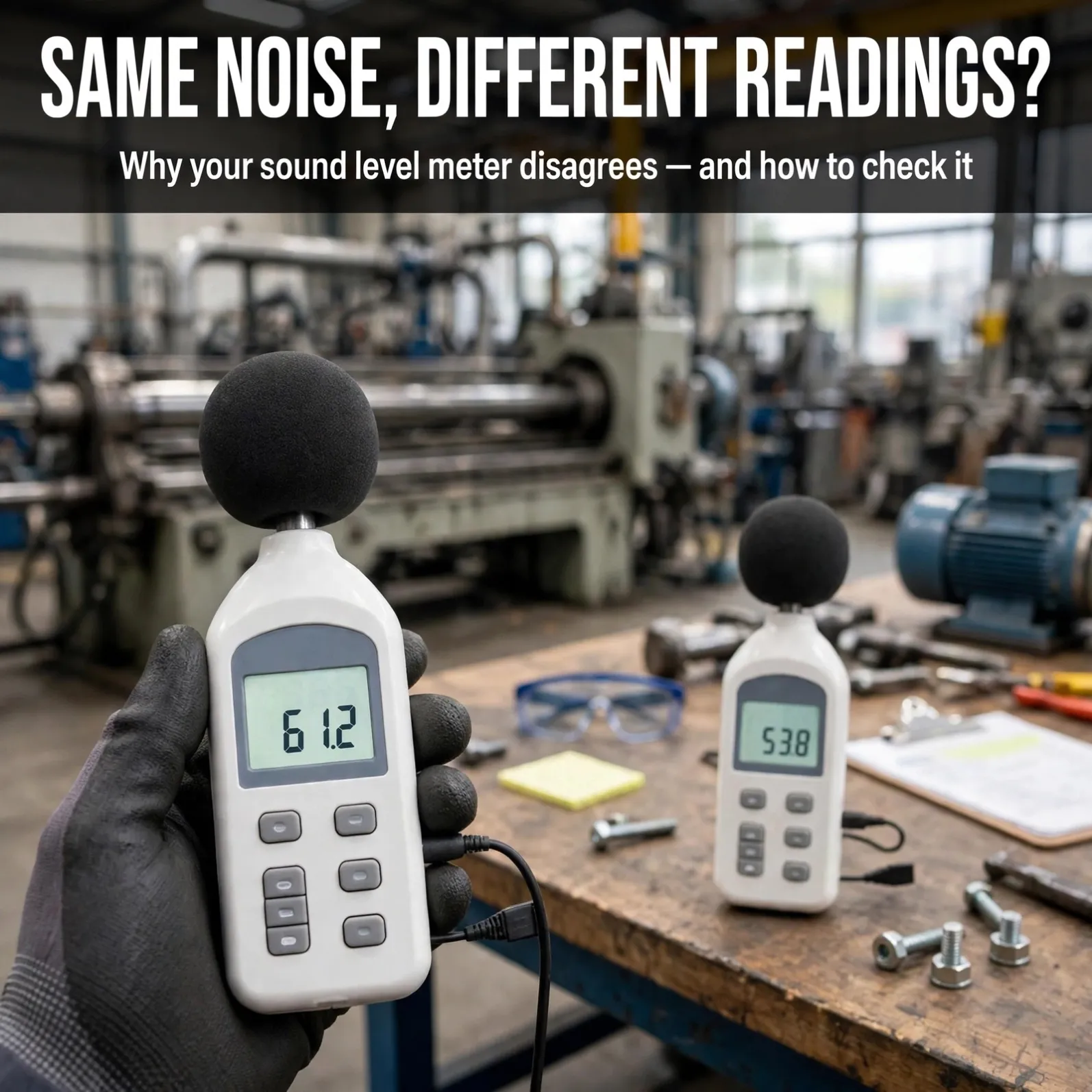
Same noise, different decibel readings? Weighting, Fast vs Slow, position and calibration explain most gaps. Five checks to run before trusting a number.
The short answer
If two sound level meters disagree on the same noise, the meter is usually not broken. In most cases the two readings answer different questions: one used A-weighting and the other C-weighting, one was set to Fast and the other to Slow, one recorded a peak and the other an average, or the two measurements were taken from different positions. Check the five causes below first.
1. A-weighting and C-weighting measure different things
A sound level meter does not hear like a flat microphone: it applies a frequency weighting, and the choice changes the number.
A-weighting (dBA) follows how the human ear hears at ordinary levels, cutting low frequencies heavily, so a rumbling compressor or diesel generator reads lower on A than the raw sound pressure. C-weighting (dBC) is nearly flat between about 31.5 Hz and 8 kHz, keeping far more low-frequency energy. On a low-frequency source, the same meter can read several decibels higher on C than on A — and neither number is wrong.
This is the most common cause of disagreement: one operator's meter is set to A, the other's to C, and the difference looks like a fault. Workplace hearing rules are normally written in dBA, so A is the right default for occupational checks. But for a low-frequency rumble or a transformer hum, the C reading carries information the A reading hides. Write the weighting down with every reading — a number without "dBA" or "dBC" next to it is not a complete measurement.
2. Fast vs Slow: the same room, two different numbers
Time weighting is the second silent setting: Fast responds with a 125-millisecond time constant, Slow with one second. Fast follows every bang and gap, Slow smooths them into a steadier number. On steady noise the two agree closely; on changing noise they do not — the same room can read 68 dB on Fast and 66 dB on Slow at the same moment, and neither is wrong.
With impact noise the gap is largest: one hammer blow can produce a 138 dB peak, a 105 dB Fast maximum, and a 95 dB Slow maximum — all three describe the same hammer. If two people report different numbers for the same machine, ask which time weighting each used before arguing about accuracy.
Most published limits assume Slow — the OSHA exposure table is written in dBA on Slow response. Comparing a Fast reading against a Slow-based limit means comparing two different quantities. For repeatable checks, use Slow for steady noise and for anything compared against a published limit, and Fast when you need to see how much a level swings.
3. Peak, maximum, and average are three different numbers
A meter displays several quantities, and mixing them up creates apparent errors of 20 dB or more.
- Peak is the highest instantaneous sound pressure, usually C-weighted, with no averaging. Peak values are always higher than any Fast or Slow reading of the same event, sometimes by 20 dB or more.
- Maximum (Lmax) is the highest time-weighted level during the measurement — the loudest moment as seen through Fast or Slow.
- Equivalent level (Leq) is the energy average over a defined period: the right number for a shift-long dose, not for a single bang.
A comparison is only valid if both instruments report the same quantity over the same period: an Leq over 60 seconds cannot be compared with a one-second Fast maximum, and a peak cannot be compared with an Leq. Before concluding one meter is wrong, confirm both screens show the same label — LAFmax, LAS, LAeq, or LCpeak — and the same duration.
4. Where you stand changes the reading
Your own body reflects and blocks sound: within one metre of the microphone it can cause errors of up to 6 dB at 400 Hz. Hold the meter at least 30 cm from your body, 50 cm if you can, and point the microphone toward the source. Walls and large machines reflect sound too, so a reading one metre from a wall differs from one in open space. If two readings disagree, repeat both from the same marked spot, at the same height, with the same orientation.
Wind is the other outdoor trap: air across the microphone adds its own noise. Outdoors, always fit the foam windscreen, and treat any reading taken in a strong breeze without one as suspect. The same applies indoors near a strong air jet from a vent or compressed-air line.
5. Calibration drift, low battery, and a tired microphone
If settings and position match and readings still disagree, check the instrument itself.
First, the battery: a low battery can affect accuracy, so replace it and re-test. Second, field calibration: check the meter against an acoustic calibrator, typically 94 dB at 1 kHz, before a session and after long storage, and adjust it per the manual if it reads off. Third, calibration history: if the correction needed keeps growing over months, that warns of microphone ageing — send the meter for laboratory calibration.
Phone apps deserve a note. In a NIOSH study, the best sound meter apps on iPhones read within about ±2 dBA of a reference system, but many apps did much worse and results varied by phone model; an uncalibrated phone gives an estimate, not a certified measurement. With an external calibrated microphone the same apps came within ±1 dB — good enough to tell a 70 dB room from an 85 dB one, but not for compliance or legal evidence.
A five-minute check before you trust a reading
Whenever two readings disagree, check:
- Same weighting? Confirm both meters show dBA or both show dBC.
- Same time weighting? Confirm Fast or Slow matches on both.
- Same quantity? Peak, maximum, and Leq are not interchangeable.
- Same position? Same marked spot and height, microphone toward the source, body 30–50 cm away, windscreen fitted outdoors.
- Calibrated and powered? Fresh battery, and a 94 dB calibrator check first.
If all five match and the meters still differ by more than their stated accuracy — typically ±1.5 dB for a handheld Type 2 meter such as the catalogue KT202 (IEC 651 Type 2, ANSI S1.4 Type 2) — the meter should go to a calibration laboratory.
What to ask a supplier before you buy
For a distributor building a sound level meter range, the questions that prevent these complaints are straightforward: does the meter offer both A and C weighting and both Fast and Slow time weighting? Does it record Leq and maximum as well as the live level? Is there data logging or USB for comparing shifts and sites — the GM1356, for example, stores 4,700 readings? What accuracy class does it meet, and can a standard 94 dB calibrator check it? Is a windscreen included?
Ask for a sample and run the five-minute check in your own workshop: measure the same machine on A and C, on Fast and Slow, from a marked spot. A meter that behaves predictably under those checks will behave predictably in your customers' hands.
To discuss sound level meters for your workplace or distributor range, or to request a sample evaluation, visit zydhardware.com and send an inquiry.