
Buying Guides
Why Your Thermocouple Thermometer Reads Wrong
Thermocouple reading wrong? Six causes — wrong type, reversed wires, cold-junction error, shallow immersion, drifted probe — and a 5-minute ice-bath check.
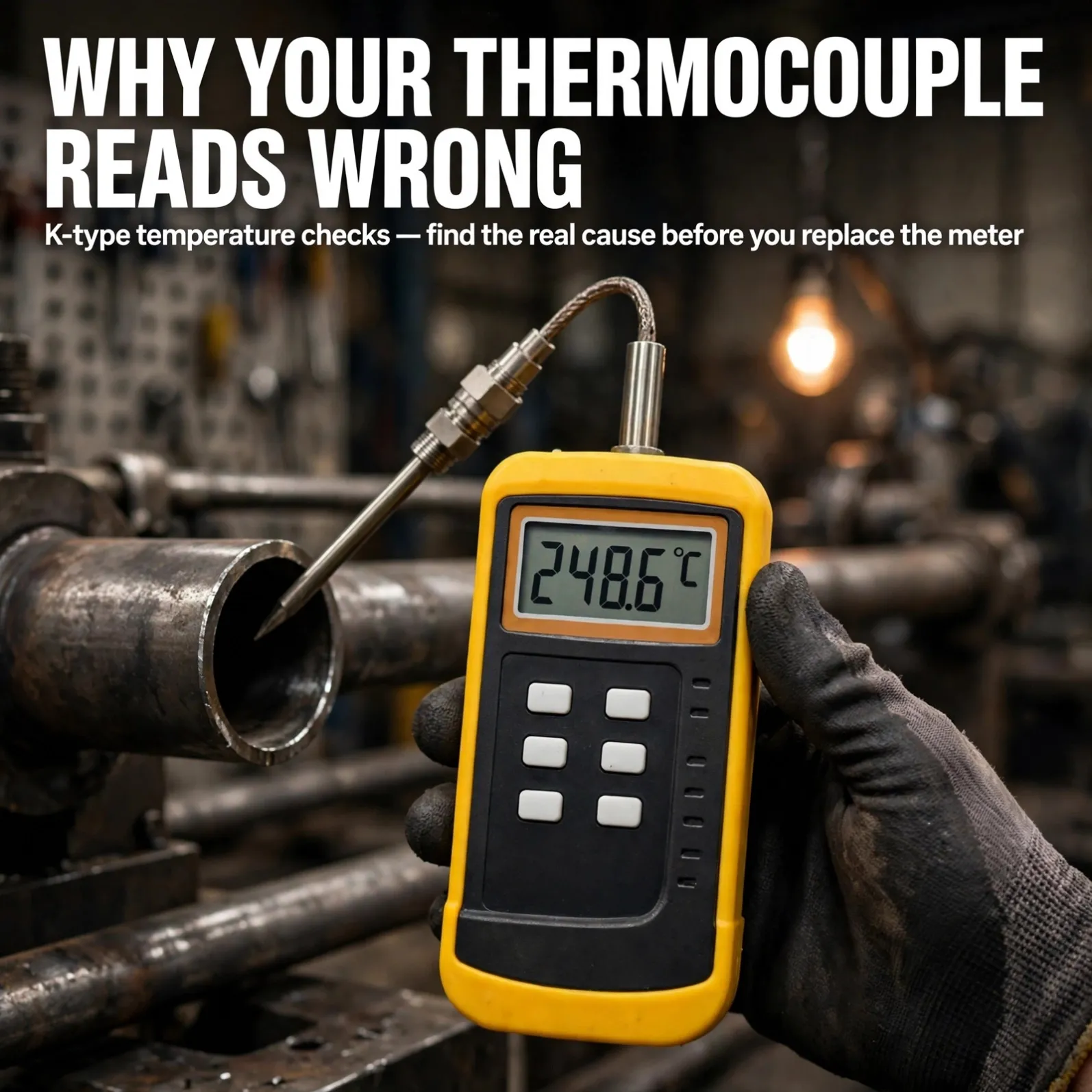
A thermocouple thermometer that reads 4 °C low at room temperature is not necessarily broken. Usually the meter is fine — the fault is elsewhere: the wrong type, reversed wires, a cold-junction error, shallow immersion, or a drifted probe.
First, Know What "Accurate" Means for a Type K Thermometer
A thermocouple does not measure absolute temperature. It measures the difference between the temperature at the probe tip and the temperature where the wires connect to the meter — the cold junction — and every link in that chain carries its own tolerance.
A standard-grade Type K thermocouple is allowed ±2.2 °C or ±0.75% of reading, whichever is greater — plus the meter's own accuracy and its compensation error, typically another 1–2 °C. One EEVblog user found his K-type probe and meter reading 4 °C low — yet the stated tolerances (0.5 °C meter, 2.0 °C compensation, 2.2 °C probe) allow up to 4.7 °C. His instrument was inside specification, not faulty.
So compare a reading with the tolerance, not with zero. The 6802II K-type thermometer states 0.1% ±0.4 °C "excluding probe error" — the probe adds its own tolerance on top.
The Six Most Common Causes
1. The wrong thermocouple type is selected
Every thermocouple type — K, J, T, E, N, R, S — is a different pair of alloys, and each pair produces a different voltage at the same temperature. If the meter is set to Type K but a Type J probe is plugged in, the reading will be completely wrong, not slightly off. This is the classic mistake after a probe is replaced: both parts work, but they speak different languages. Check that the type selected in the meter matches the marking on the probe.
2. Reversed polarity or the wrong extension wire
In the ANSI code the red thermocouple wire is negative — the opposite of what most technicians expect. Reversing the leads makes the reading wrong by roughly the temperature difference between the two ends of the leads — a negative reading on a warming process is the classic symptom. The same error happens more quietly when a probe is extended with ordinary copper wire instead of matched extension wire: the cold junction moves to a new, unknown point and the compensation no longer applies.
3. Cold-junction compensation error
Because a thermocouple only measures a temperature difference, the meter must know the temperature of its own input terminals — that is cold-junction compensation (CJC). Sunlight, a hot cabinet or a fan draught near the meter moves that temperature, and the reading follows it. Quick check: short the input — it should read close to room temperature. If not, the compensation is at fault, not the probe.
4. The probe is not immersed deeply enough
Heat travels along the sheath, so a shallow probe reads a compromise between the medium and the air. Immerse the probe at least ten times its diameter — deeper for a thick sheath or a large temperature difference — and wait until the reading settles. The same problem appears in a thermowell: a loose probe with an air gap around it reads low on a hot pipe. Thermal paste or a better-fitting well usually fixes it.
5. Drift and damage in the probe itself
Thermocouples drift with age, heat and contamination, and the dangerous part is that a drifted probe keeps giving a smooth, believable number that is simply wrong. Errors of 10–20 °F (about 5–10 °C) are common in aged probes. Type K has a specific failure mode in low-oxygen atmospheres — "green rot", where chromium is oxidised out of the chromel leg and the calibration shifts. Moisture is another: the magnesium oxide insulation inside a probe is hygroscopic, so a damaged sheath or seal lets moisture in and shifts the reading permanently.
6. Loose, dirty or broken connections
A thermocouple signal is only millivolts, so a small extra resistance is a large error. Oxidised terminals, loose screws, or a conductor cracked inside its insulation all add resistance the meter reads as a temperature change. The tell-tale sign is a reading that jumps when the cable is moved or flexed. Clean the terminals, re-terminate, and flex-test the cable before condemning the meter.
A Five-Minute Check You Can Do on Site
A crushed-ice bath is the standard field reference: fill a container with crushed ice, add just enough clean water to fill the gaps, stir, and let it settle. Immerse the probe and it should read 0 °C. Done carefully, an ice bath is good to about ±0.5 °C.
Run them in this order. Ice bath: if it reads 0 °C but is wrong at working temperature, suspect drift or the wrong type — not compensation. Swap test: the same probe on a second meter, or a known-good probe on the same meter, separates a meter fault from a probe fault. Short test: short the meter input — it should show room temperature; if not, compensation is the problem. Immersion test: push the probe deeper; if the reading moves toward the expected value, depth was the cause.
A constant error at every temperature may be corrected with an offset adjustment, if the meter supports one. An error that grows with temperature means a drifted probe — replace it.
What to Ask a Supplier Before You Buy
For a distributor or own-brand buyer, ask: which thermocouple types does the meter support, and is the type selectable? Is the stated accuracy quoted with or without probe error? Which probes are offered — immersion, surface, air and penetration — and what are their maximum temperatures? For sample evaluation, test the sample in an ice bath and against a reference instrument at your real working temperature before approving a batch — a room-temperature check alone will not catch drift or a type mismatch.
Zhanyueda's K-type range: the single-channel 6802II (−200 to 1370 °C) for field checks, the two-channel KT-TK02 for comparing two points, and the four-input TL-TK04 for multi-point monitoring — all K-type inputs, so probe and meter setting match by design. OEM and ODM options — custom logo, packaging, manual and barcode — are available for volume orders.
Quick Reference: Symptom, Cause, First Check
Symptom — Most likely cause — First check:
Off by a few degrees everywhere — CJC error or probe tolerance — Ice bath, then short test.
Negative reading while warming — Reversed polarity / wrong type — Check wiring, check type.
Drifts as the room warms — CJC disturbed, or copper extension wire — Move meter, matched wire.
Jumps when cable moves — Broken conductor / loose terminal — Flex cable, re-terminate.
Slow drift over months — Ageing, green rot, moisture — Ice-bath check, replace probe.
Reads low on hot pipe/liquid — Too shallow, or air gap in well — Immerse deeper.
A wrong thermocouple reading is usually a message about the measurement chain, not a broken meter. Check type, wiring, cold junction, immersion and probe — in that order.
Next step: if your team is seeing inconsistent temperature readings, or you need a K-type thermometer range with matched probes for your market, contact us through zydhardware.com — tell us your temperature range, probe type and order volume.