
Buying Guides
Your Test Leads Can Lie: Wrong Multimeter Readings
Worn, underrated, or loose test leads can make a good multimeter give wrong readings. Learn the warning signs and the 30-second lead test in this guide.
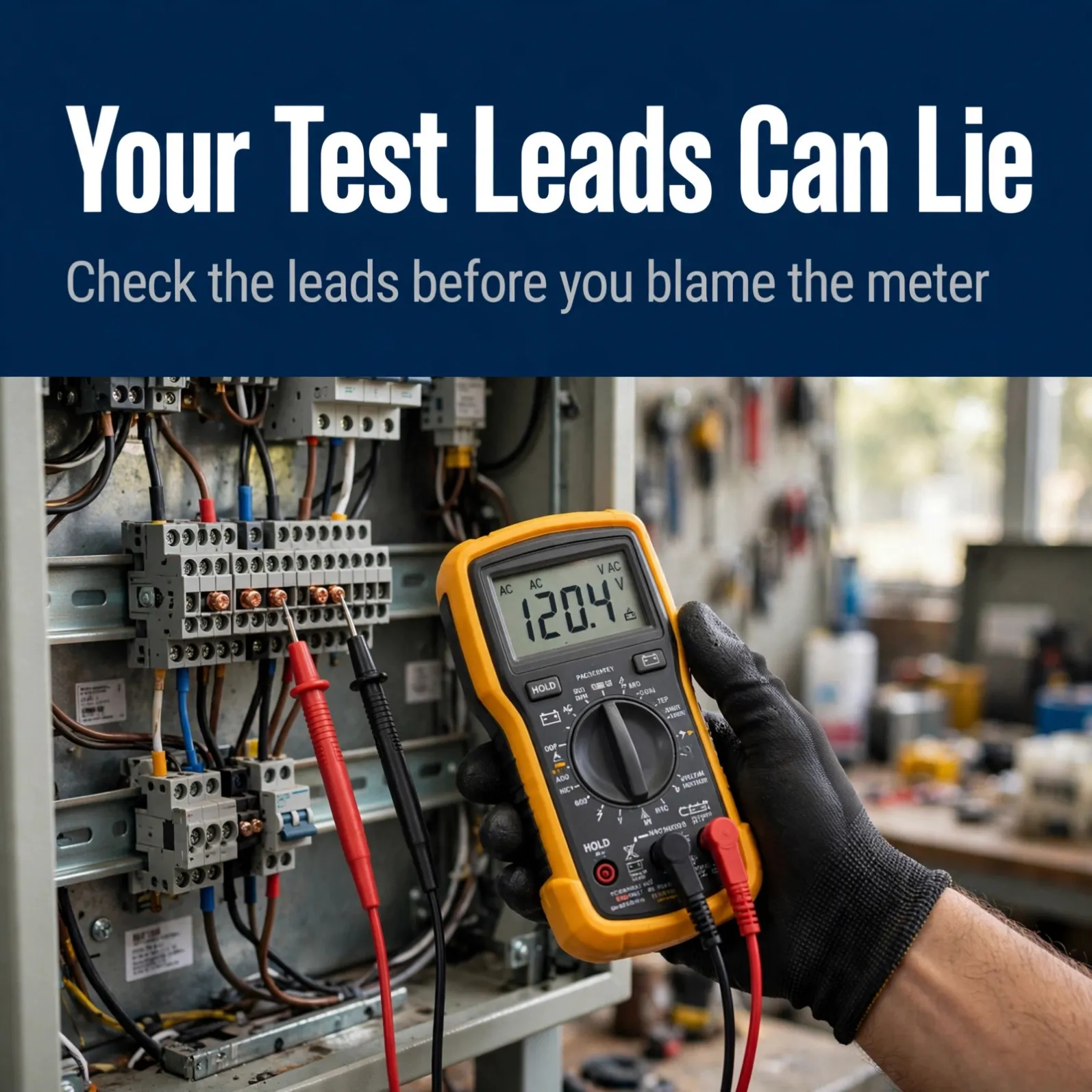
Your Test Leads Can Lie: Wrong Multimeter Readings
Your multimeter reads voltage on a circuit you know is dead, or a motor winding measures 8 ohms today and 3 ohms tomorrow. Before you blame the meter, check the cheapest part of the system: the test leads. The leads bend, get pinched in panel doors, and wear out first, yet they carry the whole signal. A perfectly calibrated meter will still give unreliable readings if its leads are the wrong type, the wrong rating, or simply worn out. Bad leads are easy to find: a 30-second test tells you whether to trust them.
Why the Leads Matter More Than the Meter
Most buyers compare meters by count, accuracy, and CAT rating, then treat the leads as an afterthought. That is backwards: the leads carry the signal, and every fault in them shows up as a meter fault.
A lead fails in four ways. The conductor inside can break from repeated bending, leaving a connection that works when the cable lies flat and opens when it moves. The probe tip can oxidise or wear, adding contact resistance. The insulation can crack or melt, exposing live metal. And the lead can be underrated for the job — a CAT II lead on a CAT III panel drags the whole system down to CAT II, no matter what the meter claims.
The failure is rarely obvious: a lead with a hairline break still beeps on continuity and still shows a voltage. It only lies when it matters — under vibration, at an angle, or on a low-resistance measurement, where a few ohms is a large fraction of the reading.
Five Signs Your Test Leads Are Lying
1. The reading changes when you move the lead. Hold the probes on a known source and flex the cable near the probe handle and the plug. If the display jumps, freezes, or drops to OL, the conductor inside is breaking. An intermittent lead can read zero on a live circuit.
2. Resistance readings are always a few ohms high. Short the probe tips together on the ohms range. Good leads read about 0.5 ohms or less. Higher readings mean the leads add resistance to every low-ohm measurement. Second-hand leads have been measured at 4.5 to 20 ohms tip-to-tip, where a good set reads near zero — enough to condemn a healthy motor winding.
3. The continuity beeper says "good" but the reading is wrong. Continuity functions are forgiving: some meters beep with up to 15 ohms in the leads. A beep proves the circuit is not open; it does not prove the leads are good. Never use the beeper as a lead test — use the ohms reading.
4. The insulation is nicked, melted, or stiff. Run your fingers along the cable and look closely at the probe handles and plugs. Cracks near the strain relief, melted spots, and exposed copper mean the lead is finished — and a meter that reads a live wire as dead because of a broken lead is how a shock hazard turns into an accident.
5. The reading drifts on a stable source. Measure a battery or a known DC supply and watch the display. A stable source with an unsteady reading points to poor contact — oxidised probe tips, a loose plug, or a worn banana connector. If the drift follows the lead after cleaning and reseating, replace it.
The 30-Second Test: Ohm Out Your Leads
This is the standard check recommended by meter manufacturers. Do it before any job where the reading matters, and on every new set of leads.
- Inspect first. Check the insulation, probe handles, and connectors for nicks or cracks, and check that the leads carry a CAT rating and voltage marking matching the meter and the work — for panel work, CAT III or CAT IV, not an unmarked lead.
- Short the tips. Set the meter to ohms, plug the leads in, and touch the red probe tip to the black probe tip. Good leads read about 0.5 ohms or less. Above that, the leads are suspect.
- Wiggle and watch. Keep the tips touching and flex each lead, especially near the probe and plug. A reading that jumps or goes open means an intermittent break inside — replace the lead, as these faults do not heal.
- Test one lead at a time. If the pair fails, test each lead separately between the ohms and COM inputs and repeat the wiggle test.
For low-resistance work, note the shorted-lead reading and use the meter's REL function to subtract it before measuring. On a 200-ohm range, test leads can add 30 counts or more of offset — significant on motor windings, invisible on a 10k resistor.
What the Recalls Reveal
In 2004, Fluke recalled its TL221, TL222, and TL224 test leads after connection faults caused incorrect readings and failures to measure voltage — 29 reports in total. The meter was fine; the connection between lead and meter was not.
The lesson: the lead is a safety component, not a free accessory. A lead rated below the meter, a loose plug, or exposed metal past the tip all reduce the protection the meter's CAT rating promises. Evaluate the leads in the box with the meter — markings, CAT rating, strain relief, and replacement availability.
Buying Test Leads: What Distributors Should Check
For importers and distributors, leads are a recurring cost and complaint — give them a line in the specification, not just "test leads included."
Check | What to verify | Red flag |
|---|---|---|
CAT and voltage marking | Printed on the lead, matching meter and application | Unmarked, or rated below the meter |
Lead resistance | New set reads about 0.5 ohms or less tip-to-tip | Several ohms on a new set |
Cable and strain relief | Flexible cable, firm strain relief at both ends | Stiff cable, loose relief, cracked insulation |
Probe design | Shrouded banana plugs, finger guards, protected tips | Exposed metal, loose-fitting plugs |
Spare availability | Replacement leads in the same rating, sold separately | Leads only sold with a new meter |
Accessories | Alligator clips, probe caps, tip options for the work | One tip style for every application |
Ask the supplier three questions before a volume order: what is the lead's CAT rating and wire specification, does the sample set pass the 30-second test out of the box, and can replacement leads be ordered separately under your own brand? For own-brand orders, put the lead specification — rating, length, plug type, tip style — in the order sheet, and check the sample leads, not just the sample meter. Shenzhen Zhanyueda supports OEM and ODM production, including logo, packaging, manual, and barcode customisation.
The Bottom Line
When a reading looks wrong, test the leads before you test the meter. Inspect the insulation, short the tips (expect about 0.5 ohms or less), wiggle the cable, and never trust the continuity beeper as a lead test. A lead that fails any of these checks costs little to replace — and a reading you cannot trust costs far more.
Need multimeters with reliable test leads? Contact us at zydhardware.com for the catalogue, sample terms, and OEM/ODM options.
Related categories: digital multimeters, clamp meters, insulation resistance testers.