
Best Multimeter for Apprentice Electricians: A Day-One Guide
Buying a first multimeter for an apprentice? Check the CAT rating, True RMS and auto-ranging first — plus the day-one kit that keeps a new technician safe.
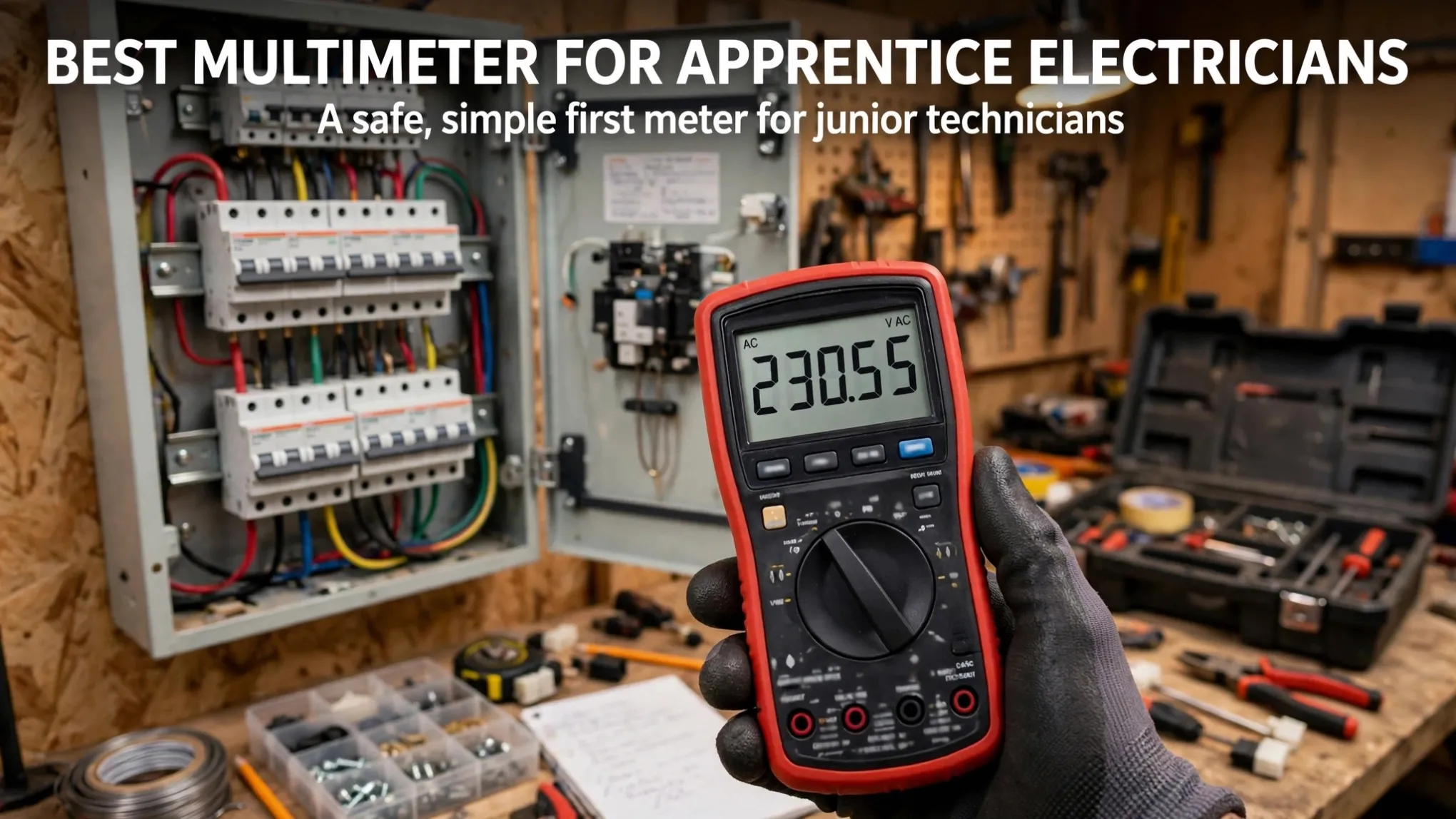
A junior technician can start real electrical work on day one with three instruments: a True RMS auto-ranging digital multimeter, a non-contact voltage tester, and a socket tester. That is the whole day-one kit; the clamp meter comes next. The buying rule: pick the meter hardest for a beginner to break by mistake, not the one with the longest feature list.
The Three Beginner Mistakes That Kill a First Meter
The first is measuring current with the leads in the wrong place. A technician measures voltage, forgets to move the red lead back from the amps jack, then touches a live circuit — and the meter becomes a short across the supply. An industry safety guide puts it plainly: with the probes in the amps jack, "the multimeter effectively becomes a phase-to-phase short," and it "can cause an arc flash." The milder version blows the fuse — the most common cause of blown multimeter fuses. Prevent it with one habit: after a current reading, move the red lead back to the VΩ jack, and check the jack before every touch on a live circuit.
The second is measuring resistance or continuity on a live circuit — those modes send the meter's own test current through the probes, so the reading is false and the meter can be damaged. Power off first, every time.
The third is using an unrated meter on real building wiring. Many cheap "7-function" meters carry no CAT rating at all — a statement about what happens during a fault, not about accuracy. An unrated meter is fine on batteries and low-voltage DC, but not across a wall outlet or inside a distribution panel. A printed "CAT III" with no independent listing behind it is, as one buyer's guide warns, just ink — ask which laboratory tested the rating, and check the leads carry the same rating.
The Day-One Checklist
What to check | Why it matters for a beginner |
|---|---|
CAT rating with an independent test mark | Decides whether the meter survives a transient on panels |
True RMS on AC voltage and current | Average meters misread motor drives, LED drivers and UPS output |
Auto-ranging | Removes the range-guessing behind most beginner errors |
Backlit display and large digits | Panels are dark; a dim display gets misread |
Non-contact voltage (NCV) | First check for live conductors, no touch needed |
Low-battery indicator | A weak battery gives unstable readings |
Leads rated to the meter's category | Cheap leads ruin a good meter; cracked insulation at the probe tip is the usual fault |
Drop protection | A first meter gets dropped; a holster and bracket decide if it survives |
Counts and extra functions matter less: 6,000 counts is enough for site work. Buy safety and readability first.
From our catalogue: the ZT-219 is a 19,999-count True RMS meter with auto/manual ranging, REL, NCV, backlight, data hold, auto power-off and 550 V protection (DC 1000 V, AC 750 V, 20 A); the ZT-M0 is a 6,000-count True RMS auto-ranging meter with the same ranges plus temperature. No CAT rating is printed for these models — confirm it for the exact model with the supplier.
The Day-One Kit, in Order
First, the multimeter. Voltage, resistance and continuity cover most first jobs: checking a circuit is dead, tracing a wire, testing a battery, confirming a fuse. A trade-school guide puts the starter kit at roughly $200–400, built around a True RMS meter rated CAT III 600 V minimum.
Second, the non-contact voltage tester and a socket tester. The NCV tester answers the key question on site — "is this live?" — without touching a conductor. A socket tester confirms wiring faults at an outlet in seconds.
Third, the clamp meter — but not on day one. It reads current without breaking the circuit — what a junior wants once motor and load-current work starts. Same rules: True RMS, a matching CAT rating, and a jaw large enough for the conductors. A 5,999-count True RMS clamp meter such as the HT208A (AC 60/600/1000 A) is the shape to look for — confirm rating and jaw size.
Not yet: the insulation tester, the LCR meter and the oscilloscope. An insulation tester applies hundreds of volts and belongs in supervised training; the others answer questions a junior is not yet asking.
Test a Sample Before Ordering a Batch
Distributors and training schools often buy first meters in batches of ten, fifty or more. Check a sample first: read it in a dim room; drop it from bench height onto concrete; flex each lead near the probe tip; check it against a known source, such as a fresh battery; and read the manual — if it is unclear in the buyer's language, the apprentice will learn the meter wrong.
Buying for a Team: OEM and After-Sales Questions
A first meter bought once is a purchase; fifty for an apprentice intake is a programme. Ask whether it can carry your own logo and packaging, whether the manual and barcode can be customised, and whether spare fuses and a spare set of leads can be included in the box — the two parts a beginner replaces first. Ask how calibration is supported, what the recommended interval is, and what happens when a meter comes back with a blown fuse. Get the warranty terms in writing, and do not accept a price, lead time or warranty figure the supplier has not confirmed for the exact model and quantity. Shenzhen Zhanyueda Technology Co., Ltd. supports OEM and ODM orders, including logo, packaging, manual and barcode, for distributors and training buyers ordering first-meter kits in volume.
Frequently Asked Questions
Do I need a True RMS multimeter as an apprentice?
Yes, for commercial or industrial work: average-responding meters can misread distorted waveforms from motor drives, LED drivers and UPS systems, and a low reading can hide a real overload.
What CAT rating does an apprentice electrician need?
CAT III 600 V minimum for panels, fixed wiring and three-phase equipment; CAT IV 600 V near the service entrance. The leads must carry the same rating as the meter.
Should a beginner buy an auto-ranging or manual-ranging multimeter?
Auto-ranging: it removes the range-guessing behind most beginner errors and is faster on site. Manual ranging helps later, when the apprentice learns how ranges work.
Can a beginner use a cheap multimeter?
For batteries, low-voltage DC and learning the dial, yes. For outlets, panels and mains work, no — unless it carries a genuine CAT rating with an independent test mark and matching leads.
Can an apprentice use a clamp meter on day one?
They can, but they do not need to: a junior's first jobs are mostly voltage, resistance and continuity. Add the clamp meter when load-current and motor work starts.
Need first-meter kits for your apprentices or your distribution range? Contact Shenzhen Zhanyueda Technology Co., Ltd. at zydhardware.com for the catalogue, sample evaluation and OEM/ODM options.