
How to Enter the Mexican Test Equipment Market as a New Brand
Entering Mexico's test equipment market? Six things new brands must get right first — delivery, portfolio, sales pay, Mexican Spanish, NOM and channels.
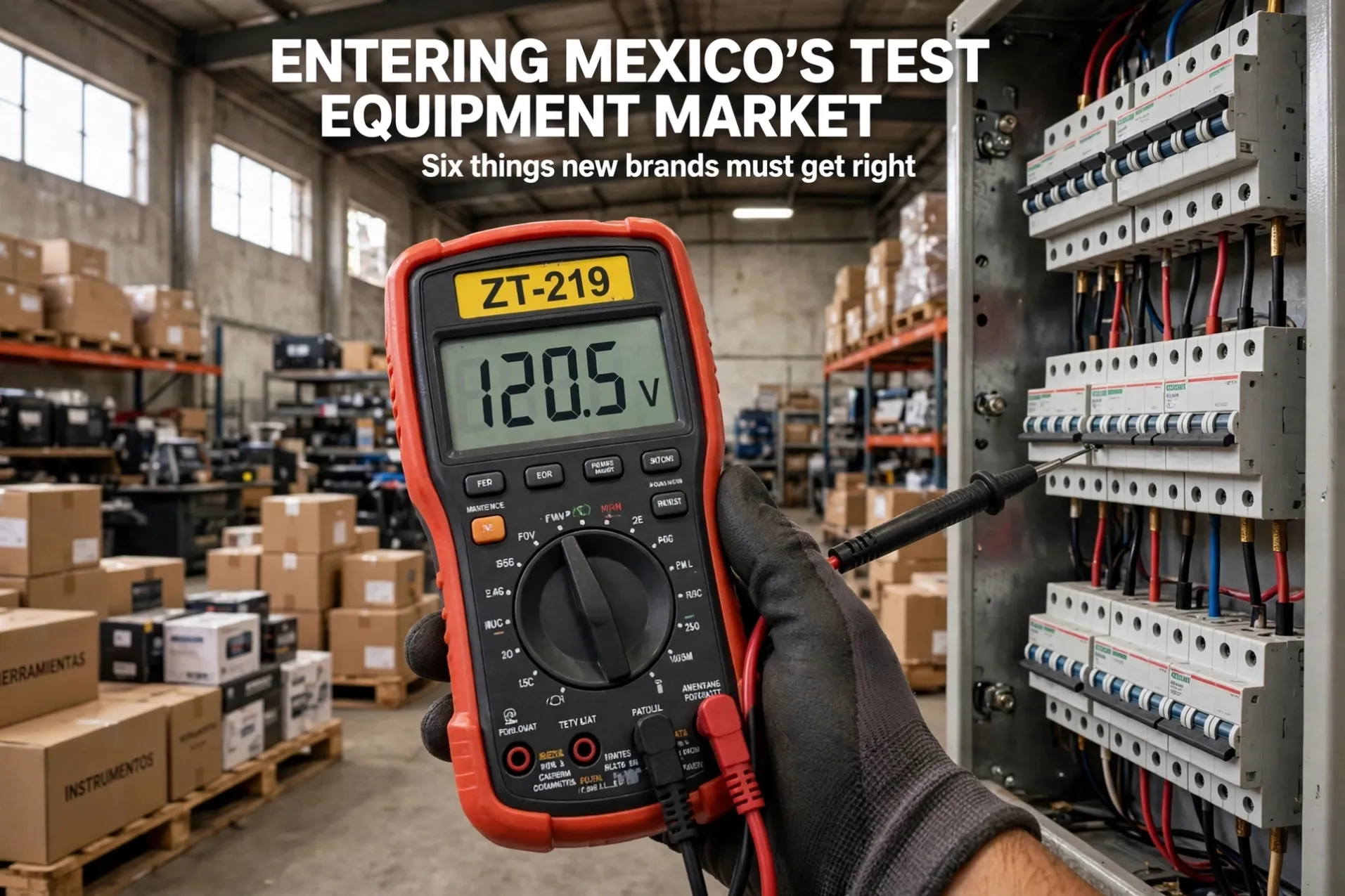
The Short Answer
Mexico rewards new test instrument brands that arrive prepared. The director general of MELTRIC de Mexico — a distributor whose team previously handled Fluke lines at WESCO — lists six conditions: "Delivery time along with a right product portfolio. Compensation package for the sales organization when is a new brand. Information in 'Mexican Spanish'. Compliance with local standards! Marketing strategy directed to sale only to distributors. The market is different for Private and Government sectors!"
Get them right and a distributor can sell your instruments; miss one and it moves on.
Why Mexico Is Worth the Effort
Mexico is roughly a US$1.8 trillion economy with 130 million people, its manufacturing deeply integrated into North American supply chains. Nearshoring keeps adding facilities that need test instruments — large enough to justify entry through one good distributor.
For most foreign companies, distribution is the first move: a distributor provides import licences, warehousing, a sales force with existing relationships, credit terms and CFDI-compliant invoicing. The six conditions are what a distributor checks before backing your brand.
1. Delivery Time Comes First — and the Portfolio Must Fit
Delivery time is the first thing a Mexican distributor asks about, because it is the first thing its own customers ask about. An instrument that arrives in eight weeks when the job starts in three is a reason to buy the competitor's stock. Confirm your real delivery time in writing, and say which models are stocked and which are made to order.
The portfolio matters as much as the speed. Mexico runs on 127 V / 60 Hz mains, so the core is the everyday workhorses: True RMS multimeters, AC/DC clamp meters, insulation and earth resistance testers, plus temperature, humidity and gas detection for HVAC and food processing. Offer a sample set — a True RMS multimeter such as the ZT-219 and a clamp meter such as the HT208A.
2. Pay the Sales Organisation Properly
A new brand has no track record, so the distributor's team takes a risk every time it recommends your instrument over a familiar one. That is why the compensation package is on the list.
Agree the package before the first order, in writing — commission rates, launch incentives, and what happens when the team closes a first order with a new customer. Also agree who pays for demonstration units, training and travel. A brand that funds the first demonstrations shares the risk.
3. Mexican Spanish, Not Translated English
Manuals, datasheets, packaging, warranty terms and website content must be in Spanish — the Spanish Mexican technicians actually read, not a machine translation.
This is also a compliance point. Mexico's commercial-information rules (NOM-024 and NOM-050) require Spanish instructions, warnings and warranty information, plus labelling with the product, brand, model, origin and importer's name and address. Use a translator who knows the trade vocabulary; a literal translation reads as a brand new to Mexico.
4. Compliance With Local Standards: NOM
Compliance with local standards is the condition that stops shipments at the port. Mexico's mandatory standards are the NOMs (Normas Oficiales Mexicanas): electrical and electronic products generally need NOM safety certification before they can be legally imported and sold. The exact NOM for a given instrument depends on its category and tariff classification — confirm it with a certification body at planning time.
Three facts surprise new brands. First, the holder must be a Mexican company with a tax ID (RFC) — a foreign brand cannot hold it directly, so your distributor or a local representative holds it. Second, certificates are issued by ANCE and NYCE, the bodies approved under the Ministry of Economy system, and tested by accredited Mexican laboratories; a CB or UL report does not substitute. Third, the certificate lasts one year and is renewed annually, with a product sampled from the market and retested. Allow roughly four to eight weeks for the process — start before you need the stock.
5. Sell Only Through Distributors
A new brand's marketing in Mexico should be directed to sale only to distributors — that is how the market works. End users buy through distributors they already trust, on credit terms and with local service — not from an unknown foreign brand's website.
Selling direct while recruiting distributors loses both: the distributor sees a competitor, and the end user sees a brand with no local support. Commit to the channel. Give the distributor Spanish datasheets, demonstration units, a clear price list and a named factory contact — and protect the channel in writing: territory, exclusivity, and what happens if an end user contacts you.
6. Private and Government Are Two Different Markets
Treat the private and government sectors as two entries, not one. Private buyers — factories, contractors, maintenance firms — decide on price, availability and the distributor's recommendation. Government buyers — utilities, state-owned plants, public works — buy through tenders with formal specifications, documented compliance and longer cycles.
Do not promise both on day one. Start with the private sector, where the distributor's relationships do the work, and learn tender requirements before bidding for government business. When you do bid, check the specification line by line: a tender asking for a specific standard, a calibration certificate or a local warranty will disqualify a bid that cannot show it.
What to Ask a Mexican Distributor Before You Sign
Get these answers in writing: which models will it stock, and what delivery time can it promise? What commission and launch support does it need? Who holds the NOM certificate, and which models are certified? Are manuals and packaging already in Mexican Spanish? Is the arrangement distributor-only, and what territory? Private sector first? What does it need from the factory in the first 90 days — samples, training, demonstration units? A distributor that answers directly is giving you a plan; one that will not is giving you a hope.
Frequently Asked Questions
Do test instruments need NOM certification to sell in Mexico?
Generally yes. Electrical and electronic products need NOM safety certification to be legally imported and sold, and customs can hold a shipment without it. Confirm the exact NOM with ANCE or NYCE first.
Who can hold a NOM certificate?
Only a Mexican company with a tax ID (RFC). A foreign manufacturer cannot hold it directly, so the distributor or a local representative normally holds it.
Can a foreign brand sell directly to end users in Mexico?
In practice, no — end users buy through distributors they trust, on credit terms and with local service.
How do I find a distributor in Mexico?
Use trade data: customs records show which companies already import your type of instrument, by HS code, volume and origin. Expo Manufactura in Monterrey is the other practical route.
What language should manuals and labels be in?
Mexican Spanish. Labelling rules require Spanish instructions, warnings and warranty information, plus the product, brand, model, origin and importer's details.
Planning to enter Mexico with handheld test instruments? Start with the six conditions above. Visit zydhardware.com, tell us your target models and quantities, and we will confirm availability, delivery time and the documents needed.