
How to Test an EV Charger with an EVSE Tester
An EV charger that will not start is not always broken. Learn how an EVSE tester checks the earth, CP signal and RCD trip — and what to ask before you buy.
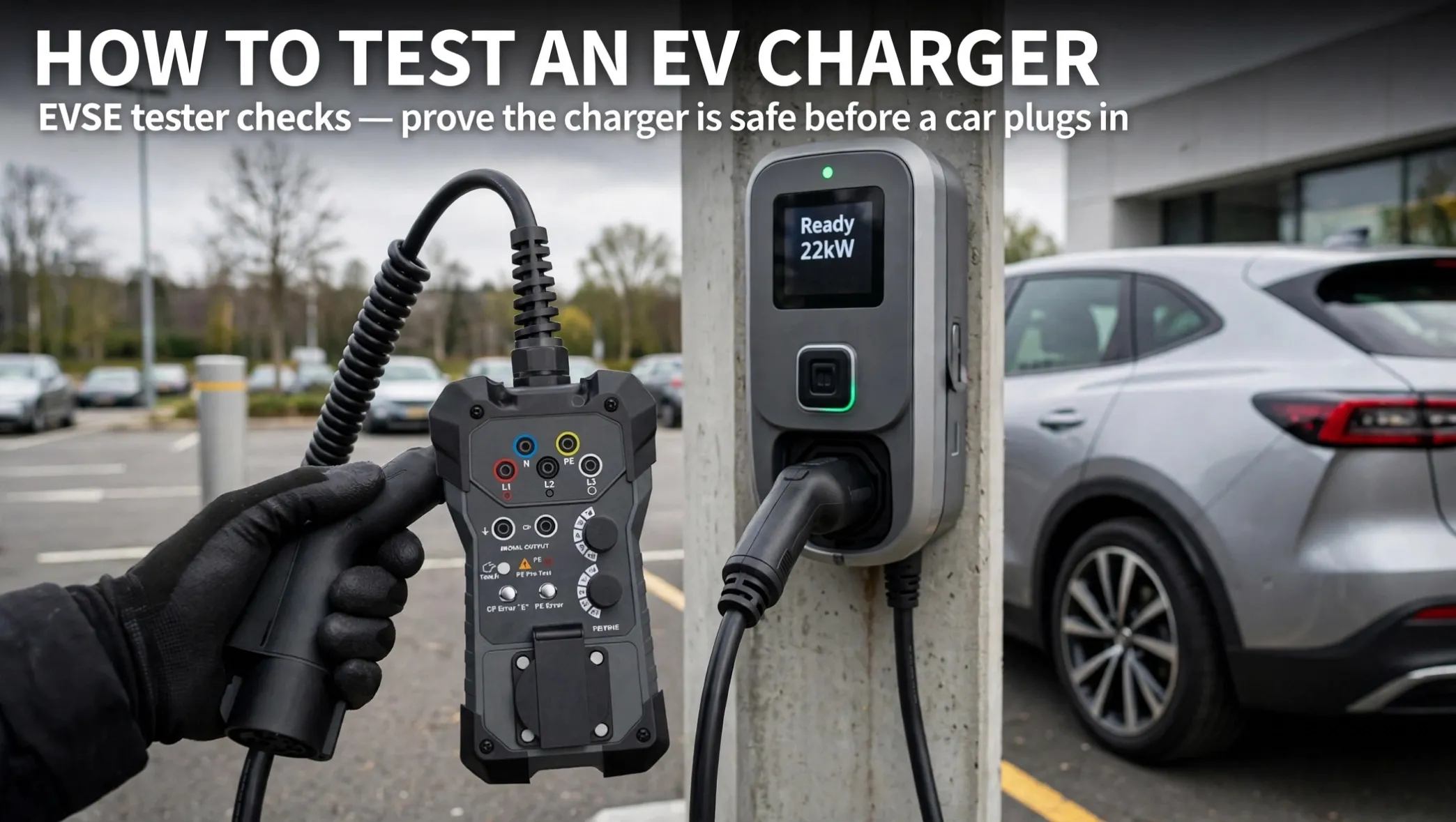
How to Test an EV Charger with an EVSE Tester
An EV charger that refuses to start is not necessarily broken — and one that starts is not necessarily safe. The only way to know is to test it the way a vehicle would: an EVSE tester plugs into the charging point, pretends to be a car, and walks the charger through every state it must handle. Here are the seven checks a proper test covers, and what to look for in a tester.
Why a Multimeter Alone Cannot Test a Charger
A Mode 3 AC charge point is deliberately awkward to test: its outlet stays dead until the charger is satisfied that a vehicle is connected, earthed and ready. The contactor inside is open, so there is no voltage at the connector to measure.
The dead tests — continuity, insulation resistance, polarity and earth fault loop impedance — can still be done at the supply terminals. What you cannot do without an EVSE tester is test at the vehicle connector, or exercise the protective devices built into the charger. The IET Code of Practice for Electric Vehicle Charging Equipment Installation treats functional checks as part of inspection and testing.
The Seven Checks, in Order
Test in the same sequence every time, safety first.
1. Protective earth pre-test. The tester puts the charger into a charging state and checks the earth through a touch pad: PROCEED or FAULT. It confirms the earth exists, not how much current it can carry. A failure stops the test until an electrician repairs the earth.
2. Protective conductor resistance. The tester measures resistance between the earth pin and a test point on its handle. The trade pass/fail limit is 0.5 ohms; a high reading points to a loose or corroded earth connection.
3. Touch voltage. This checks that a faulty earth cannot raise the charger frame to a hazardous voltage while someone touches it. Any significant voltage on the frame is a direct shock risk.
4. RCD or GFCI trip time. The tester applies a calibrated leakage current — typically 30, 20 or 6 mA — and measures how long the protective device takes to trip. One that is too slow, or never trips, is replaced.
5. Nuisance tripping check. Some chargers trip for no apparent reason. This check looks for extraneous currents behind nuisance tripping, such as the capacitive charging of long cables.
6. Proximity pilot (PP). The proximity pilot tells the charger a plug is inserted and, on an untethered unit, what current the cable is rated for. The tester simulates ratings — typically 13, 20, 32 or 63 A — set to match the charge point.
7. Control pilot (CP) states. The control pilot is how charger and vehicle signal state to each other: the vehicle changes its voltage to say "connected" or "ready", and the charger uses a pulse-width signal to advertise the current available:
CP state | What the tester simulates | What the charger should do |
|---|---|---|
A | No vehicle connected | Outlet stays dead |
B | Vehicle connected, not ready | Recognise vehicle; outlet dead |
C | Ready to charge | Energise the outlet |
D | Ready, ventilation required | Energise with ventilation demand |
E | CP error (short to earth) | Stop charging immediately |
The CP signal can also be checked with an oscilloscope through the tester's CP output: the duty cycle defines the current available, the amplitude the charger state. State E is the key safety check — a charger that keeps charging when the CP signal fails cannot be trusted.
When a Test Fails
Read the failure, not just the pass/fail light. A PE fault means the earth is missing — stop and call an electrician. A charger dead in state C has a contactor or control fault. One that keeps charging in state E ignores a CP fault and must be taken out of service.
Many "charger won't charge" complaints are not charger faults at all. Before testing the hardware, check the vehicle's schedule, charge limit and connector seating — a car set to charge at midnight, already at its limit, or with a connector not fully latched will simply not start.
What to Look for When Buying an EVSE Tester
Match the connector standard first. A tester built for one connector cannot test another. The three standards in common use are SAE J1772 (Type 1, North America), Type 2 (European standard) and NACS (Tesla); the PM701 series maps one model to each.
Check the functions, not just the plug. A useful tester simulates charging states A, B, C and D, runs PE and CP pre-tests, simulates cable resistance, and can deliberately create CP and PE errors to prove the charger reacts correctly. It should also test earth leakage tripping — the PM701 series tests tripping at 6 mA and above.
Look for proper terminals and a real safety rating. The tester should expose 4 mm safety terminals for L1, L2, L3, N and PE, plus CP and PP signal outputs, so you can connect your own multimeter or oscilloscope and verify voltages and the CP waveform directly. Look for a CAT III 600 V rating to IEC/EN 61010-1 and IEC/EN 61010-2-030, an IP54 enclosure and fuse protection — the PM701 series is rated IP54 with a 10 A / 250 V fuse.
Evaluate a sample before ordering in volume. Test the sample on a charger you already know is good: every state should behave as the table describes, and the CP error test must stop charging. For a distributor or own-brand buyer, confirm the connector standards, single- and three-phase support, error simulation, calibration interval and OEM or ODM options.
Frequently Asked Questions
Can I test an EV charger without an electric car? Yes — that is what an EVSE tester is for: it simulates the vehicle, so no car is needed.
Why won't my EV charger start charging? Check the car's schedule and charge limit, then the connector seating and the breaker or GFCI.
What does CP state C mean? The vehicle is connected and ready to charge, so the charger should energise the outlet. If it does not, the fault is in the charger.
Do I need a different tester for Type 2, J1772 and NACS chargers? Yes. Each standard needs a matching tester — PM701U for J1772, PM701E for Type 2, PM701UT for NACS.
How often should a charging station be tested? On installation, after any repair, and as part of regular preventive maintenance.
Can a normal socket tester check an EV charger? No — the outlet stays dead until the CP handshake, which a socket tester cannot simulate. Only an EVSE tester can.
For a charging point your customers can trust, test it like a vehicle would — contact Shenzhen Zhanyueda Technology Co., Ltd. at www.zydhardware.com for samples and OEM/ODM options.