Refrigerant Leak Detector Incoming Inspection: A 12-Point QC Checklist for Distributors
Use this 12-point refrigerant leak detector inspection checklist to verify sensitivity, repeatability, false alarms, accessories and batch consistency.
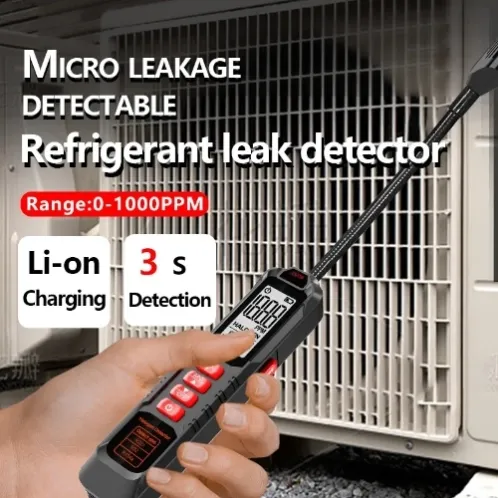
A refrigerant leak detector can power on, beep near an open bottle and still be a poor product for professional HVAC/R service. For a distributor, importer or private-label brand, the real question is whether units from the same production lot respond consistently to a defined refrigerant leak under controlled conditions.
That distinction matters because a missed leak creates callbacks and lost refrigerant, while a detector that alarms on cleaning chemicals, oil vapour or its own unstable baseline wastes technician time. Both problems become expensive after hundreds of units have entered a sales channel.
This guide provides a practical incoming-inspection plan for handheld electronic refrigerant leak detectors. It is designed for B2B buyers who need a repeatable screen for samples and production batches—not a substitute for a laboratory type test, regulatory assessment or the manufacturer’s model-specific instructions.
Quick answer: what should incoming inspection prove?
A useful incoming inspection should show that the detector:
- is the exact approved model and configuration;
- covers the refrigerants stated in the purchase specification;
- completes warm-up and establishes a stable clean-air baseline;
- detects a documented reference leak repeatedly;
- responds and recovers within the agreed time window;
- does not produce excessive false alarms under the defined test conditions;
- has consistent sensitivity modes, alarms, probe construction and accessories; and
- can be traced to its lot, inspection record and approved reference sample.
The most important rule is simple: define the test before the shipment arrives. If the refrigerant, leak rate, temperature, probe distance, sweep speed and pass/fail rule change from one inspector to another, the results cannot be compared.
Why a product-page sensitivity claim is not enough
Leak-detector specifications are often reduced to one large number. That number may describe a concentration range in parts per million, a minimum detectable leak rate in grams per year, an alarm level or a laboratory result obtained with one refrigerant. These are different quantities.
For automotive air-conditioning service, SAE J2791 establishes minimum performance criteria for electronic probe-type detectors used with specified refrigerants. Other markets and applications may use different standards or procedures. A supplier should therefore identify the exact standard edition, refrigerant, test method and model configuration behind any conformity claim. A generic report or a statement that a detector is “high sensitivity” does not establish fitness for your customers’ work.
A buyer’s incoming inspection has a narrower purpose. It checks whether delivered units match the approved sample and respond consistently to a controlled challenge. It does not create certification, and it should not be described as calibration unless the process truly meets the applicable metrological requirements.
Build the test plan before approving a sample
| Define in the purchase specification | Record during inspection | Risk if left undefined |
|---|---|---|
| Exact model, firmware or hardware version and included accessories | Label photos, carton code, serial or lot number, accessory count | A visually similar but different configuration may be shipped |
| Target refrigerant or refrigerant family | Reference-leak gas identity and certificate | A detector may respond differently to different refrigerants |
| Reference leak rate and uncertainty | Reference ID, nominal value, temperature and validity status | A random gas release cannot support a defensible sensitivity result |
| Warm-up, zeroing and test environment | Ambient temperature, airflow, background and elapsed warm-up time | Baseline drift may be mistaken for sensitivity |
| Probe distance, movement and exposure duration | Fixture position, sweep speed and time to alarm | Different operators can obtain different pass/fail results |
| Acceptance limits and retest rule | Individual results, repeats, failures and disposition | Borderline units may be accepted inconsistently |
Where the result is used for a formal performance claim, the reference and measurement chain should be documented. NIST describes metrological traceability as an unbroken, documented chain of calibrations, each contributing to measurement uncertainty. Simply buying a reference device or writing “NIST traceable” on a certificate does not by itself prove that every result is fit for purpose.
The 12-point refrigerant leak detector incoming-inspection checklist
1. Verify identity, refrigerant coverage and ordered configuration
Match the unit, carton, manual and purchase order. Confirm the model number, sensor type, probe style, power source, sensitivity modes, accessories and intended refrigerants. If the order includes private-label artwork, check that the manual and carton still identify the correct technical configuration.
Do not infer compatibility from the words “halogen detector.” Ask for a model-specific refrigerant list. A detector intended for halogenated refrigerants is not automatically suitable for ammonia, carbon dioxide, hydrogen tracer gas or combustible refrigerants.
2. Inspect packaging, housing and accessories
Check for shipping damage, loose parts, cracked housings, unreadable labels and inconsistent moulding. Verify the flexible probe holds position without exposing wiring. Confirm that the sensor cap, filter, batteries, case and instructions match the approved bill of materials.
Packaging inspection is not cosmetic. A missing filter or poorly protected probe can change field performance before the customer uses the instrument.
3. Measure power-up and warm-up behaviour
Start each sampled unit in clean air and time the complete warm-up sequence. Record abnormal resets, low-battery indications and alarms during stabilization. Sensor technologies have different warm-up behaviour, so compare units with the model-specific requirement rather than imposing one universal time.
A detector that is challenged before it stabilizes may appear more sensitive than it really is, or may false-alarm because the baseline is still moving.
4. Check the clean-air baseline and zeroing
After warm-up, hold the probe in the defined clean-air area. Confirm that the indication remains stable and that automatic or manual zeroing behaves as described. Move the unit away from the test bench between challenges so residual refrigerant does not become the new baseline.
Record background sources such as solvent, aerosol, oil vapour or recently opened refrigerant containers. The goal is to test the instrument, not the contamination history of the room.
5. Use a documented reference leak
Challenge the detector with a reference leak appropriate to the refrigerant and expected sensitivity. Record the reference ID, nominal leak rate, uncertainty or certificate information, temperature and expiration or service status where applicable.
Do not test sensitivity by briefly cracking a cylinder valve or loosening a hose connection. The released amount is uncontrolled and can saturate the sensor. Good leak-testing guidance recommends a reference leak because an arbitrary gas release is not accurate enough to verify detector performance.
6. Test repeat detection, not one successful beep
Run several defined challenge-and-recovery cycles. A single alarm proves only that the instrument responded once. Repeated trials expose intermittent sensors, unstable zeroing, poor connectors and units that respond strongly on the first exposure but weakly afterward.
Keep the reference position, probe angle, sweep speed and exposure time constant. If the procedure includes multiple sensitivity modes, test them in a fixed order and allow the detector to recover between trials.
7. Record response and recovery separately
Response time is the interval from the defined start of exposure to the agreed alarm indication. Recovery is the time required for the indication to return to the defined baseline after the probe moves back to clean air.
Both matter in the field. Slow response can cause a technician to pass the probe over a leak before the alarm rises. Slow recovery can make it difficult to pinpoint the source because the detector continues alarming after the tip has moved away.
8. Confirm sensitivity-mode behaviour
Where a detector offers low, medium and high sensitivity, verify that the modes change the response in a logical, repeatable way. Check the mode indicator and confirm that the unit does not silently return to a different setting after power cycling unless the manual says it will.
More sensitivity is not always better. A useful high mode should reveal smaller challenges without making the detector unusable in a background concentration. Buyers should evaluate the complete behaviour, not only the easiest mode to demonstrate in a sales video.
9. Screen for false alarms and cross-sensitivity
Under a written, safe procedure, observe the detector in clean air and near common non-target conditions relevant to the customer environment. The test should be selected with the supplier and should never involve exposing staff to unsafe substances.
Repeated alarms without the target refrigerant may indicate contamination, a damaged sensor, poor filtering or sensitivity to interfering vapours. The purchase specification should define which cross-sensitivity information the supplier must disclose. “No false alarms” is too broad to be meaningful without test conditions.
10. Check probe, tip, filter and service parts
Flex the probe through the agreed inspection cycle and confirm it holds its position. Inspect the sensor tip, protective cap and filter. Verify that replaceable filters or sensors are available under stable part numbers and that the replacement procedure is documented.
For a distributor, service-part continuity affects the real product cost. A low initial price can be offset by early sensor replacement, unavailable filters or complete-unit returns for minor damage.
11. Verify alarms, controls and field usability
Check audible, visual and vibration alarms where fitted. Confirm button operation, display legibility, backlight, mute behaviour, battery installation and low-battery warning. Test any automatic power-off function against the manual.
These features do not determine analytical sensitivity, but they affect whether a technician can use the detector in a noisy plant room, dark equipment bay or restricted service position.
12. Compare units and retain lot-level records
Review the sampled units as a group. Look for wide spreads in warm-up time, alarm time, recovery or baseline stability even when every unit technically passes. A drifting distribution can reveal a production change before it becomes a high return rate.
Retain the purchase order, lot identity, sample selection, reference-leak details, environmental conditions, individual results, failures, retests and disposition. Keep an approved reference sample only if it is stored and rechecked under a controlled process; an old “golden unit” with an ageing sensor is not a permanent truth standard.
Do not mix up ppm, grams per year and ounces per year
| Expression | What it describes | Procurement question |
|---|---|---|
| ppm | A concentration ratio at a defined point and condition | Is this the displayed range, alarm threshold or tested detection concentration? |
| g/year or g/a | A mass leak rate over time | Which refrigerant, reference leak and test procedure support the value? |
| oz/year | A mass leak rate in imperial units | Was the value converted correctly, and is the original test evidence available? |
| Response time | Time to a defined indication under stated exposure conditions | What starts and stops the timer, and at what refrigerant level? |
A ppm value cannot be converted directly into grams per year without a defined flow, geometry, time and test setup. Treat marketing copy that uses “ppm sensitivity” and “minimum leak rate” as if they were interchangeable as a specification risk.
The current ZYD ZL77 refrigerant leak detector page uses a 1000 ppm statement in its title. Before a bulk order or regulated-use claim, buyers should confirm whether that number describes a concentration range, an alarm level or another test result, then request the refrigerant, method and supporting production specification. This is exactly the kind of ambiguity an approved purchase specification should resolve.
How many units should a distributor inspect?
There is no responsible universal sample count for every shipment. The plan should reflect lot size, supplier history, product maturity, field risk and the consequence of a missed defect. New models, first production runs, engineering changes and previous failures justify tighter inspection.
A practical plan may combine:
- 100% checks for identity, packaging, obvious damage and accessory count;
- a documented random sample for functional and reference-leak testing;
- expanded or full inspection when failures exceed the agreed acceptance rule; and
- periodic comparison with retained records to detect long-term drift.
If your organization uses an AQL-based sampling system, define defect classes carefully. A missing case and a detector that misses the agreed reference leak should not automatically carry the same severity.
Questions to send with an RFQ
- Which refrigerants has the exact model been tested with?
- What quantity does the sensitivity claim describe, and what are the units?
- Which standard, edition and test method support any compliance statement?
- What reference leak or calibration gas is used at final inspection?
- What are the specified warm-up, response and recovery conditions?
- What sensor technology is used, and what is the expected service interval?
- Are the sensor, filter and probe replaceable, and are spare parts orderable?
- How are firmware, sensor or component changes controlled between batches?
- Which production records can be linked to the carton or lot code?
- Can the supplier provide pre-shipment samples and a batch inspection report?
For a broader feature and application comparison, read How to Choose a Refrigerant Leak Detector. Buyers assembling a wider HVAC/R or industrial inspection range can also review the ZYD test and measurement product catalog.
Frequently asked questions
Is a bump test the same as calibration?
No. A functional challenge or bump test shows that a detector responds to a known stimulus under the test conditions. Calibration establishes a defined relationship between a reference and the instrument result and normally includes documented values and uncertainty. Do not use the terms interchangeably in inspection records.
Can I check a detector by opening a refrigerant cylinder?
That can show that the unit reacts to a large release, but it does not verify a stated minimum leak rate. The release is uncontrolled, may saturate the sensor and creates avoidable exposure and emissions. Use an appropriate documented reference leak and follow safe handling rules.
Why should the same refrigerant be used for the test?
Sensor response can vary by refrigerant. A successful test with one gas does not prove the same response to every refrigerant on a marketing list. The challenge gas should match the claim being verified or the relationship should be supported by the applicable test method.
What causes batch-to-batch variation?
Possible causes include sensor tolerance, component substitution, filter material, firmware, assembly, contamination, ageing and test-fixture variation. Lot records and controlled inspection conditions help separate product variation from test variation.
Should every unit receive a reference-leak test?
That depends on risk, production controls and the agreed inspection plan. The manufacturer may perform 100% functional testing while the importer verifies a statistically selected sample. Critical customers or an unstable supplier history may justify expanded inspection.
Does passing incoming inspection prove regulatory compliance?
No. Incoming inspection confirms only the defined checks on the sampled shipment. A regulatory or standard-conformity claim requires the applicable assessment and evidence for the exact model and market.
Turn a specification into a repeatable supply program
The strongest leak-detector purchasing programs do not depend on a dramatic showroom demonstration. They define the refrigerant, reference, environment, procedure and acceptance rule, then compare every shipment against the same controlled expectation.
ZYD works with HVAC/R distributors, industrial tool importers and private-label brands that need model comparison, sample evaluation, packaging support and batch documentation. Share your target refrigerants, customer applications, destination market and inspection requirements to discuss a suitable detector configuration and pre-shipment quality plan.