
What Does OL Mean on a Multimeter? (And When to Worry)
OL on a multimeter means overload or open loop: the value is beyond the range, or there is no connection. What it means in each mode, and when it is a fault.
The short answer
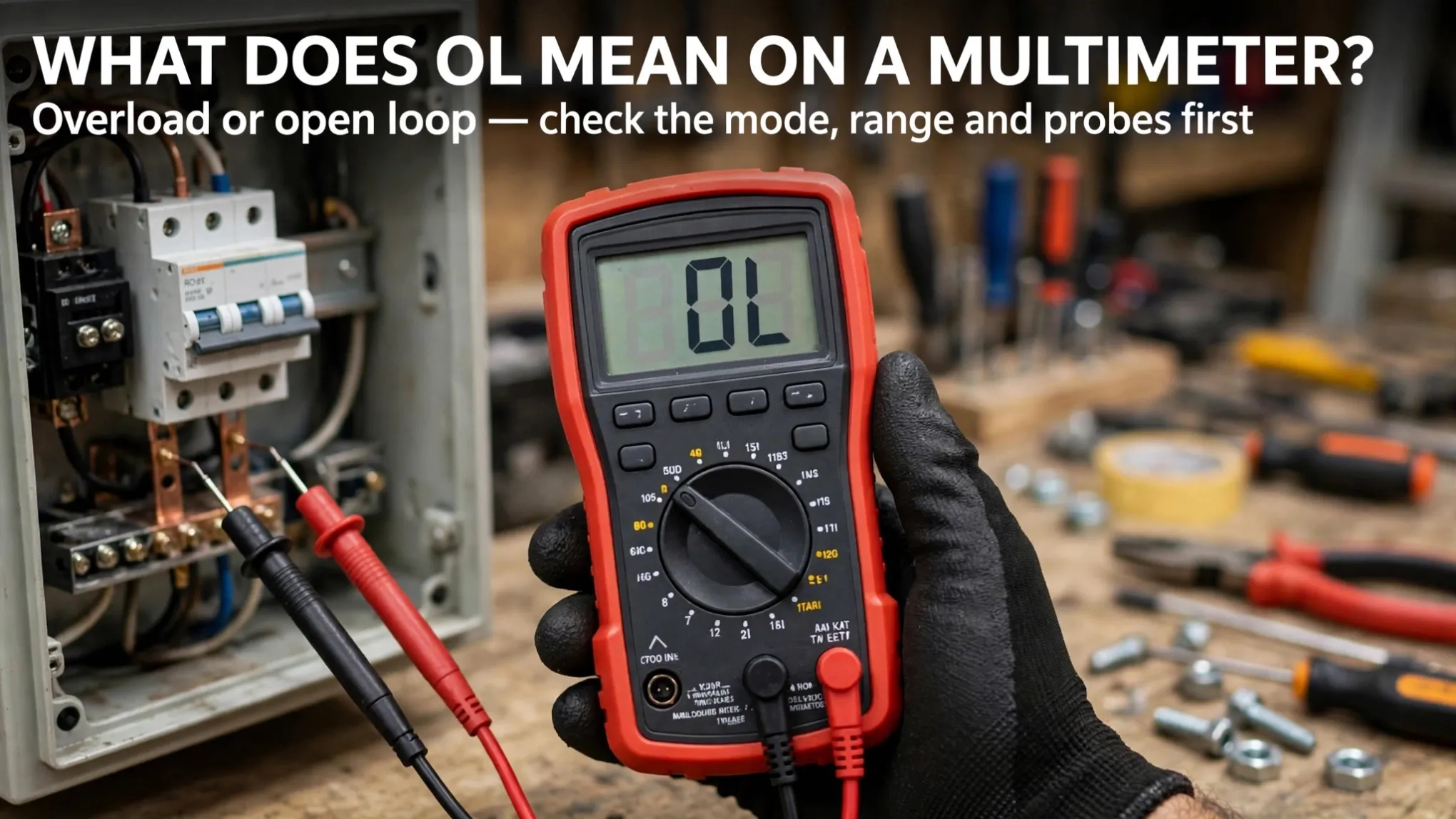
OL stands for Overload — or, on some meters, Over Limit. It means the value the meter is trying to measure is outside what the selected range can show. On a resistance or continuity test it usually means there is no connection at all, so the resistance is effectively infinite. On a voltage or current test it usually means the range is too low. OL is rarely a sign that the meter is broken — check the mode, the range and the probes first.
1. One message, six meanings
OL changes its meaning with the dial position. Some older meters show a lone "1" instead of OL — it means the same thing.
Mode | What OL means | Most likely cause |
|---|---|---|
Voltage | Voltage above the selected range | Range set too low |
Resistance | Resistance above the range, or no path | Open circuit, or range too low |
Continuity | No connection between the probes | Broken wire, open switch, bad contact |
Current | Current above the selected range | Range too low, or a blown fuse |
Diode test | No forward conduction in this direction | Diode reversed, or failed open |
Capacitance | Capacitance above the selected range | Range too low, or a shorted capacitor |
2. OL when measuring voltage: the range is too low
This is the most common OL for beginners. On a manual-ranging meter, a 2 V range cannot show 12 V, so the display shows OL. Step up to a higher range until a number appears, or switch to auto-ranging. A good habit: start on the highest voltage range and step down.
If OL appears on auto-ranging too, stop. The voltage may be above the meter's absolute maximum — typically 600 V or 1,000 V on a handheld meter, depending on the model. Confirm the expected voltage from the equipment nameplate first, and use a meter rated for it.
3. OL when measuring resistance or continuity: usually the right answer
With the probes held in the air, a healthy meter in resistance mode shows OL. That is correct: air is an insulator, so the resistance between the probes is effectively infinite. New users often expect zero — but zero would mean a perfect short circuit.
So OL on a resistance test is a diagnosis, not an error. If you expect a connection and you get OL, something is open: a broken wire, a blown fuse, an open switch, or a probe not really touching the metal. If you expect no connection, OL confirms it. The same applies to continuity mode: OL with no beep means there is no low-resistance path between the probes.
But "OL" and "broken" are not synonyms: a 1 MΩ resistor on a 200 kΩ range shows OL even though the resistor is fine. Step up the range and the real value appears.
Never measure resistance or continuity on a live circuit. Disconnect the component where possible, so parallel paths cannot fool the reading.
OL and 0 are opposites, and beginners mix them up. OL means "too much to measure" — too much resistance, or no path at all. Zero means "nothing there" — no resistance, a direct short. A good wire beeps near 0 Ω; a broken wire shows OL and silence. A corroded joint may show a small resistance without a beep, and can still fail under load.
4. OL when measuring current: check the fuse first
Current is the one mode where OL can mean the meter itself has a problem — a blown internal fuse. Measuring current on the wrong socket, or above the range, blows the fuse. After that, the current ranges show OL or zero no matter what you connect.
Check the fuse on the resistance range: with the meter off, a good fuse shows a very low resistance; a blown fuse shows OL. Replace it with exactly the same type, voltage and current rating — never a higher rating, and never a piece of wire. Also check the red probe is in the current socket. Measuring current means breaking the circuit and putting the meter in series with the load; probing across a voltage source in current mode is the classic way to blow the fuse.
5. The five-minute check when you see OL
Work through this list before you replace anything.
- Short the probes together. In resistance or continuity mode you should get a beep and a reading near zero. If you still get OL, try another set of leads.
- Check the dial and the sockets. Voltage, resistance and continuity use the V/Ω socket; current uses the A socket. The wrong socket is the most common beginner mistake.
- Step the range up. Keep stepping up until a number appears. If the highest range still shows OL on resistance, the circuit really is open or the value is beyond the meter.
- Check the contact. Press the probe tips firmly onto clean, bare metal. Paint, rust and oxide are insulators — a probe sitting on paint reads OL on a perfectly good wire.
- Check the fuse. If current ranges show OL and everything else works, the current fuse is the prime suspect.
If the meter passes these checks, trust the OL: it is telling you something true about the circuit.
Frequently Asked Questions
Is OL a good reading on a multimeter?
It depends on the mode. On resistance or continuity, OL is often the correct answer — it means the circuit is open. On voltage it usually means the range is too low, so step up the range or switch to auto-ranging.
Does OL mean no continuity?
Yes. In continuity mode OL means there is no low-resistance path between the probes — the circuit is open somewhere. Check the probe contact first, then look for a broken wire, an open switch or a failed component.
Why does my multimeter show OL with the leads in the air?
Because air is an insulator. In resistance or continuity mode the meter sees infinite resistance between unconnected probes, and infinite is beyond every range. OL with open probes is normal — and a quick way to confirm the meter is working.
Can OL mean the multimeter is broken?
Rarely. Short the probes together in resistance mode: a working meter reads near zero. If it still shows OL, or the current ranges show OL after the fuse has been checked, the meter itself may be faulty.
Get a meter your team can trust
If your technicians lose time to confusing readings, get a meter that matches the work — auto-ranging, a clear OL indication, and ranges that cover the values you actually measure. A sample worth testing shows OL with open probes, near zero with shorted probes, and a stable value on a known resistor. Shenzhen Zhanyueda Technology Co., Ltd. supplies handheld digital multimeters, clamp meters and related test instruments for distributors, importers and own-brand buyers, with OEM and ODM support. Contact us through zydhardware.com for a catalogue and sample quotation.