
Why Your Multimeter Misbehaves in Cold Weather
Cold slows a multimeter's LCD, drains its battery and pushes readings outside their accuracy. Learn what is normal, what is a fault, and how to stay accurate.
The short answer
If your multimeter acts strangely on a cold morning — slow display, dim numbers, drifting readings, dying mid-job — the cold is the most likely cause, not a fault in the meter. Low temperature slows the liquid-crystal display, drains the battery faster, pushes readings outside the range where accuracy is guaranteed, and stiffens the test leads until they crack. Most symptoms disappear when the meter warms up. The exception matters: a weak battery in the cold can produce a wrong voltage reading, and a wrong "0 V" on a live circuit is a safety problem.
1. The display goes slow, dim or blank
A multimeter display is a liquid-crystal display, and liquid crystals change with temperature. As the meter gets cold, the crystal fluid thickens, so numbers take seconds to update, look dim, or lag behind the measurement; some displays black out below about 0 °F (-18 °C) and recover once warmed up. EEVblog technicians describe the same effect from Canadian winters at -20 °C: "the LCD display fluid starts to freeze up."
A slow or blank display in the cold is usually temporary. Warm the meter gradually — inside your jacket or in the vehicle cab — and give it 15 to 30 minutes, no heater: sudden heat can cause condensation. If the display stays dim after warming up with a fresh battery, that is no longer a cold effect.
2. The battery gives up first — and a weak battery can lie
Cold hits the battery before it hits the electronics. Alkaline batteries lose much of their usable capacity below freezing because the chemical reaction inside them slows down.
A weak battery does more than shorten working time: it can produce false readings. In December 2010 the U.S. Consumer Product Safety Commission recalled 5,100 Extech meters (EX540–EX570 multimeters and EX612–EX623 clamp meters) because a low battery could make them show an inaccurate voltage reading, leaving the operator falsely believing the power was off. That is the dangerous combination cold weather creates: the cold drains the battery, and the drained battery lies about voltage.
Prevent it: fit fresh lithium batteries before a cold job, carry spares warm in a pocket, and never trust a "0 V" reading from a meter showing its low-battery symbol.
3. Readings drift outside the rated accuracy window
Every accuracy figure is only guaranteed inside a narrow temperature band. Fluke's published figures give an operating range of -10 °C to +50 °C, but accuracy is guaranteed only at 18 °C to 28 °C. Many generic handheld meters list 0 °C to 40 °C operating and guarantee accuracy at 25 °C ± 5 °C.
"Operating range" means the meter will switch on and show a number; "accuracy range" means that number is within tolerance. A meter can work at -5 °C and still be outside its accuracy specification, because the internal voltage reference drifts with temperature — EEVblog testers measured around 100 ppm/°C on low-cost meters.
Do not certify a borderline reading taken in the cold: warm the meter, let it stabilise, and re-check — or apply the manual's temperature coefficient if one is published.
4. Leads stiffen and crack, and condensation follows you indoors
At -20 °C, test-lead insulation — especially PVC — turns hard and brittle and can crack at the strain relief. A cracked lead is a safety hazard as well as a measurement problem: intermittent contact looks exactly like a jumping reading.
The second trap is bringing the cold meter indoors: condensation collects on and inside the case, and moisture across the input terminals can cause unstable readings. Let it warm up in its closed case before measuring anything above low voltage.
5. A five-minute cold-weather routine
Use this routine below about 5 °C:
- Keep the meter warm until you need it. Carry it inside your jacket or in the heated cab, not in an open toolbox.
- Fit fresh lithium batteries. Lithium cells hold their voltage in the cold far better than alkaline cells. Carry spares warm in a pocket.
- Let the meter acclimatise. Give it 15 to 30 minutes at the working temperature before you trust a reading.
- Verify on a known source — a second meter on the same point, or a fresh battery whose voltage you confirmed at room temperature.
- Store it indoors. Never leave a meter in an unheated vehicle or garage overnight in winter, and take the battery out if you will not use it for weeks.
6. Buying for cold climates
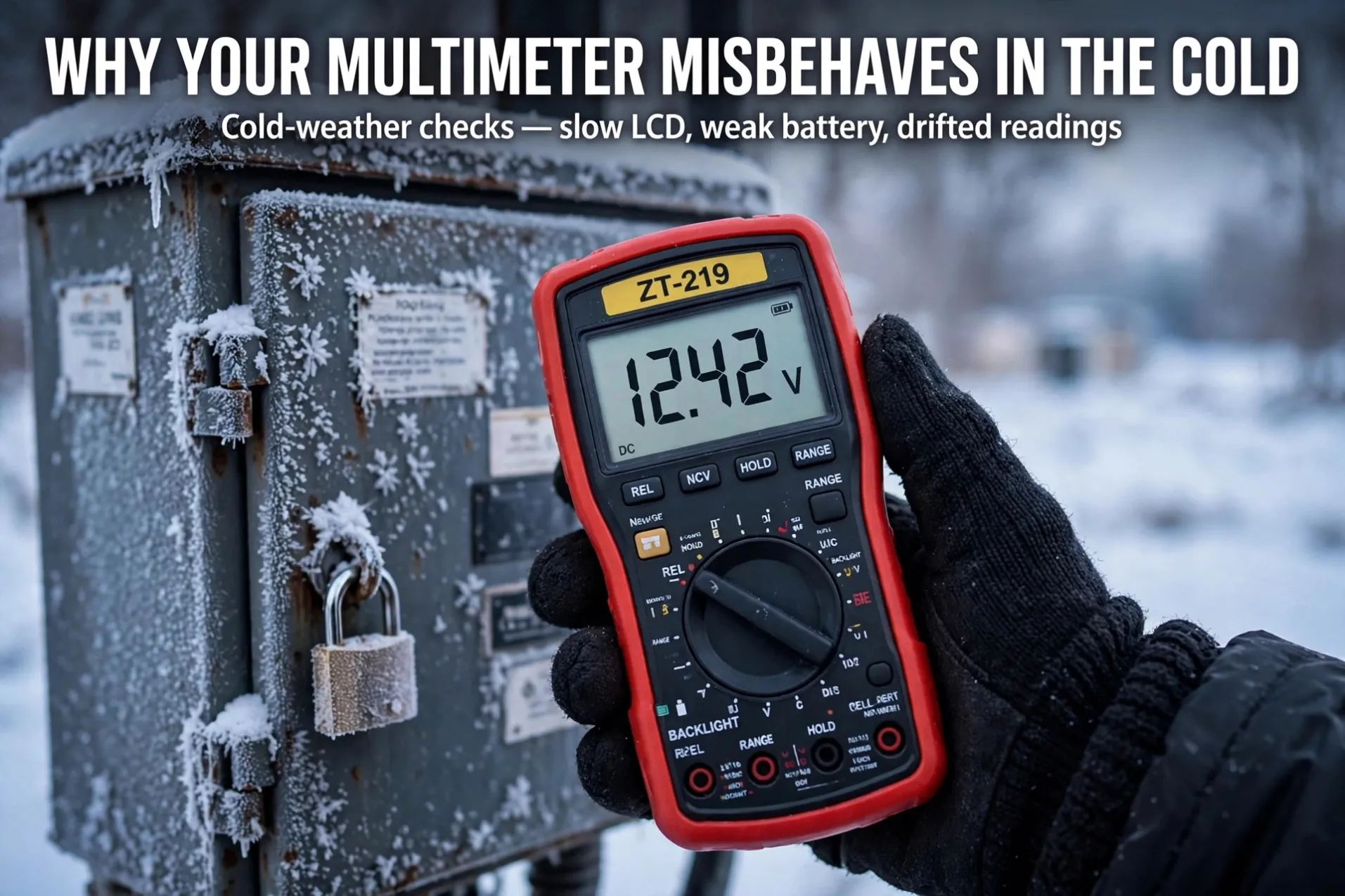
For distributors serving Canada, Northern Europe or any market with real winters, cold-weather behaviour is a buying specification. Ask your supplier: the operating temperature range, not just storage; the accuracy temperature window and whether a temperature coefficient is published; the display type — LCDs slow down in the cold, OLEDs keep working but cost more; and whether the low-battery warning is clear. Models such as the ZT-219 (19,999 counts, True RMS, low-battery alert, backlight, auto power-off) show the feature set to look for — confirm the operating range for the exact model in its manual. Ask for silicone-insulated leads, which stay flexible far below the temperature where PVC stiffens.
Frequently Asked Questions
Can cold weather damage a multimeter?
Usually not permanently: the LCD and battery recover when the meter warms up. Real damage comes from cracked leads, leaking batteries left in a stored meter, and condensation when a cold meter is brought indoors.
Why is my multimeter display slow in cold weather?
The liquid crystal thickens as the temperature falls, so numbers can take seconds to update or disappear below about -18 °C. This is normal for LCD technology, not a fault, and it reverses when the meter warms up.
Why does my multimeter show a wrong reading when the battery is low?
A low battery can distort the meter's internal reference voltage. In 2010, CPSC recalled 5,100 Extech meters for this exact failure: with a low battery they could show an incorrect voltage, making the operator believe a circuit was dead. Replace the battery at the first warning and re-test.
What temperature can a multimeter operate in?
It depends on the model — check the manual. Fluke publishes -10 °C to +50 °C operating, accuracy guaranteed only at 18 °C to 28 °C; many generic meters list 0 °C to 40 °C. Below the rated range, treat every reading as indicative until confirmed at room temperature.
Conclusion
Cold weather does not usually break a multimeter, but it changes everything it does — display, battery, accuracy, leads. Keep it warm, fit fresh lithium batteries, let it acclimatise, and verify it on a known source before you believe it.
Get a quote or a sample: sourcing multimeters, clamp meters or other handheld test instruments for a cold-climate market? Contact Shenzhen Zhanyueda Technology Co., Ltd. at www.zydhardware.com — tell us your operating temperature range and we will help you choose the right model, with OEM/ODM branding and packaging to match your market.