How Technicians Choose Their First Multimeter — and Why That Choice Can Last for Years
Learn how training, instructor recommendations, safety, core functions and usability shape a technician’s first multimeter—and future brand preference.
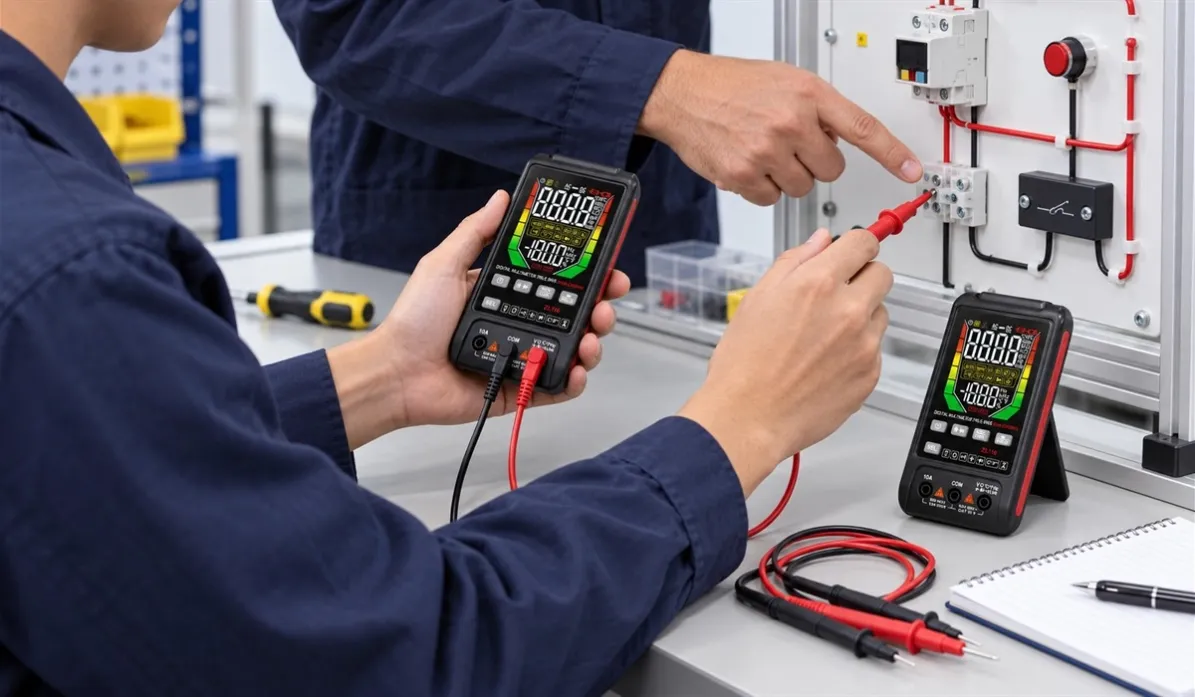
Brand trust often starts before a technician gets their first job.
The multimeter used in a classroom, training workshop or apprenticeship may become the reference point for every meter that follows. The user learns where the controls are, how quickly continuity responds, how the display behaves and what the test leads feel like. Those details gradually become expectations.
This does not mean technicians will never change brands. It means a new meter is rarely judged against a blank page. It is compared with the instrument the user already knows.
For distributors and private-label brands, the first-meter market is therefore more than an entry-level price segment. It is an opportunity to build familiarity, confidence and a relationship that can continue as the technician’s work becomes more demanding.
Quick answer: a good first multimeter should match the trainee’s actual work, provide reliable core measurements, use clear controls and documentation, include suitable safety ratings and test leads, and remain consistent from unit to unit. Extra functions matter only when students can understand and apply them.
Why the first multimeter has an outsized influence
Learning a trade requires repeated actions. A trainee selects a function, connects the leads, checks the display, interprets the reading and decides what to do next. Repeating that sequence on the same meter builds familiarity.
Familiarity reduces mental effort. The technician no longer has to stop and search for every function or indicator. More attention can go to the circuit, the symptom and the safety procedure.
The first meter can also shape the user’s definition of “normal.” A fast continuity buzzer, stable autoranging, a readable display and flexible leads may become expected. Slow response, confusing symbols or inconsistent controls can become equally memorable.
That early experience does not guarantee permanent loyalty. Employers, applications, budgets and technical requirements change. But when two suitable meters appear similar, the familiar operating logic often has an advantage.
Who influences a technician’s first meter choice?
The trainee is not always the only buyer. The decision may be influenced by several people and channels:
- Instructors choose instruments that are practical to demonstrate and easy to supervise.
- Training centres and vocational schools need repeatable units, documentation and manageable replacement costs.
- Employers may specify approved tools or issue a standard kit.
- Journeymen and senior technicians recommend what they already know and trust.
- Distributors influence availability, after-sales support and the models included in apprentice programs.
- Online educators and trade communities expose new technicians to familiar names and workflows.
A supplier that speaks only to the individual end user misses much of the actual decision chain.
What makes a good first multimeter?
The answer depends on the work the trainee is learning. An electrical apprentice, HVAC student, automotive trainee and electronics student do not face the same circuits or need the same functions.
| Training application | Likely priorities | Questions for the buyer |
|---|---|---|
| Electrical installation | Voltage, resistance, continuity, suitable measurement category, clear lead connections | Where will the meter be used, and what safety requirements apply? |
| HVAC/R service | AC voltage, resistance, continuity, capacitance, temperature and application-appropriate current measurement | Will students work on controls, motors, capacitors or flame-sensing circuits? |
| Automotive service | DC voltage, resistance, continuity, current, frequency or duty cycle | Is the training focused on basic electrical systems or electronic diagnostics? |
| Electronics repair | Low-voltage resolution, resistance, current, diode, capacitance and stable readings | What ranges and input characteristics are needed for the components being tested? |
| Industrial maintenance | True RMS, Min/Max, frequency, durable construction and appropriate input protection | Which equipment and electrical environments will technicians encounter? |
The best first meter is not necessarily the cheapest model or the one with the most functions. It is the simplest instrument that safely supports the required training outcomes without becoming obsolete as soon as the trainee enters the field.
Core functions should be easy to learn—and hard to misuse
Clear input jacks and function selection
Students make connection mistakes while learning. Logical jack placement, legible markings and understandable mode selection help instructors demonstrate correct procedures and spot errors quickly.
Predictable continuity
Continuity is one of the first functions many students use. A predictable buzzer helps them understand closed and open paths without making the tool itself the source of uncertainty. The threshold and response should be consistent across classroom units.
Stable, readable measurements
A rapidly changing display can confuse a beginner who is still learning what the reading means. Autoranging behavior, display refresh, backlight, units and annunciators should all be evaluated on real samples.
Test leads that support good habits
Test leads are part of the measurement system, not a disposable afterthought. Buyers should evaluate insulation, flexibility, strain relief, finger guards, connector fit, contact quality and ratings. Training providers also need a reliable supply of compatible replacements.
Documentation written for the learner
A specification table is not a training manual. New users benefit from clear diagrams, function explanations, warnings and examples of correct lead placement. For international programs, accurate local-language instructions may matter as much as another measurement mode.
Safety cannot be reduced to a CAT number
A meter used only on low-voltage electronics and one used in an electrical distribution environment require different safety considerations. The buyer should define the intended environment before comparing ratings.
Measurement categories describe transient conditions associated with where a measurement is made. They are not a general ranking of product quality. The category and voltage rating should be suitable for the application and supported by documentation for the exact model and configuration.
The complete system matters: meter, fuses, input protection, probes and leads. A high rating printed on the housing does not compensate for unsuitable or damaged accessories. Training must also cover inspection, correct lead connections and the approved procedure for verifying the instrument before and after relevant tests.
For a focused explanation, see CAT III vs CAT IV Multimeter: Understanding Measurement Categories.
Why feature overload can work against training
A long function list looks competitive in a catalog, but it can make a first meter harder to teach. Combined buttons, hidden secondary modes and crowded displays increase the number of decisions a student must make before measuring anything.
That does not mean a training meter must be basic. It means every included function should have a clear purpose for the target course or job.
| Approach | Advantage | Possible drawback |
|---|---|---|
| Simple core-function meter | Easier to demonstrate and less distracting | May need replacement when the technician’s work expands |
| Application-focused meter | Functions match a specific trade such as HVAC or automotive service | Less suitable outside that workflow |
| Feature-rich general meter | Can support progression into more advanced tasks | More complex controls and a higher training burden |
Distributors should help training customers choose deliberately rather than assuming that more features always create more value.
How early familiarity becomes long-term brand preference
Several forms of familiarity can continue after training:
- Interface familiarity: controls and symbols require less relearning.
- Measurement familiarity: the technician knows how the display and continuity function respond.
- Accessory familiarity: leads, cases and replacements are already understood.
- Support familiarity: manuals, distributors and service channels are known.
- Social proof: classmates, instructors and co-workers use the same platform.
As the technician progresses, the original meter may be replaced by a more capable model. A brand with a clear product ladder can make that upgrade feel less risky.
How new brands can enter the training market credibly
1. Build a training-ready model, not merely a low-cost model
Reliable core functions, clear controls and dependable accessories matter more than reaching the lowest possible price.
2. Give instructors useful samples
One demonstration unit may reveal obvious issues. A small multi-unit evaluation is better for checking consistency, classroom usability and how easily learners understand the interface.
3. Provide teachable documentation
Quick-start material, diagrams, specifications and warnings should use the same names and symbols that appear on the meter. Private-label buyers should verify translations before production.
4. Make product claims verifiable
Accuracy, measurement category and compliance statements should be tied to the exact model. Distributors need documentation they can review, explain and retain.
5. Keep production consistent
A training provider may add units over several terms. Unannounced changes to controls, firmware, leads or accessories create avoidable retraining and support problems.
6. Plan the next meter
A first meter should connect logically to more advanced models for field service, HVAC, automotive diagnostics or industrial maintenance. A clear upgrade path gives distributors a reason to keep the customer within the range.
7. Listen to instructors and technicians
Training environments expose confusing labels, awkward controls and documentation gaps quickly. That feedback can improve both the product and the way it is presented.
The related guide Why Technicians Prefer Familiar Multimeters — and How New Brands Can Earn Their Trust explains how the same trust factors continue in professional field use.
A distributor checklist for first-meter programs
- Define the training application and likely first-job environment.
- List the core functions students must learn.
- Confirm suitable ratings and documentation for the intended use.
- Evaluate the meter and test leads as one system.
- Check display readability, continuity response and control logic.
- Compare several units for consistency.
- Review manuals, translations and quick-start materials.
- Confirm replacement leads, fuses and other consumable parts.
- Record an approved sample and change-control requirements.
- Map an upgrade path for technicians who need more capability later.
For a broader sourcing framework, use How to Compare Multimeter Specifications: A 10-Step Buyer’s Guide.
Frequently asked questions
What multimeter should an apprentice buy first?
Start with the tasks and electrical environment covered by the apprenticeship. Choose suitable safety ratings, dependable leads, clear controls and reliable voltage, resistance and continuity performance before considering extra functions.
Does a beginner need a True RMS multimeter?
It depends on the signals being measured. True RMS becomes important for many non-sinusoidal AC waveforms found around electronic controls, drives and some HVAC equipment. It should be selected because the application needs it, not simply as a marketing label.
Is a cheaper multimeter better for training?
Lower purchase cost helps when equipping a class, but total value also includes consistency, lead replacement, documentation, durability and support. A very low-cost model can become expensive if units behave differently or require frequent replacement.
Should every student use the same multimeter?
Standardized units make demonstrations and troubleshooting easier. Instructors can give one sequence of instructions and compare student results more efficiently. Small variations may be useful later when teaching instrument selection.
How can a new multimeter brand win training customers?
Offer verifiable specifications, instructor samples, clear teaching material, dependable accessories, consistent production and responsive technical support. The objective is to reduce the risk of adopting an unfamiliar product.
Why do technicians remain loyal to the meter they learned on?
They understand its controls and behavior, and that familiarity reduces uncertainty. Loyalty is not automatic, but a positive early experience gives the brand a useful advantage when the technician buys or recommends the next instrument.
The first meter is the beginning of a product relationship
Training buyers are not simply purchasing low-cost instruments. They are helping technicians form measurement habits that may influence years of future tool choices.
For distributors and emerging brands, the opportunity is to earn that familiarity responsibly: with a meter that fits the application, supports safe instruction, behaves consistently and has a logical path to more advanced tools.
ZYD supplies digital multimeters and professional test instruments for distributors, wholesalers and private-label programs. Buyers evaluating meters for training kits or entry-level product ranges can review the ZYD ZL116 True RMS rechargeable digital multimeter and browse the ZYD test and measurement catalog. Share the target trade, market and required functions, and we can recommend models for sample evaluation and OEM/private-label development.