
Test Instruments for Food, Pharma and Environmental Work
Food, pharma and environmental buyers need handheld instruments for temperature, humidity, gas and more — see what each job requires and how to choose.
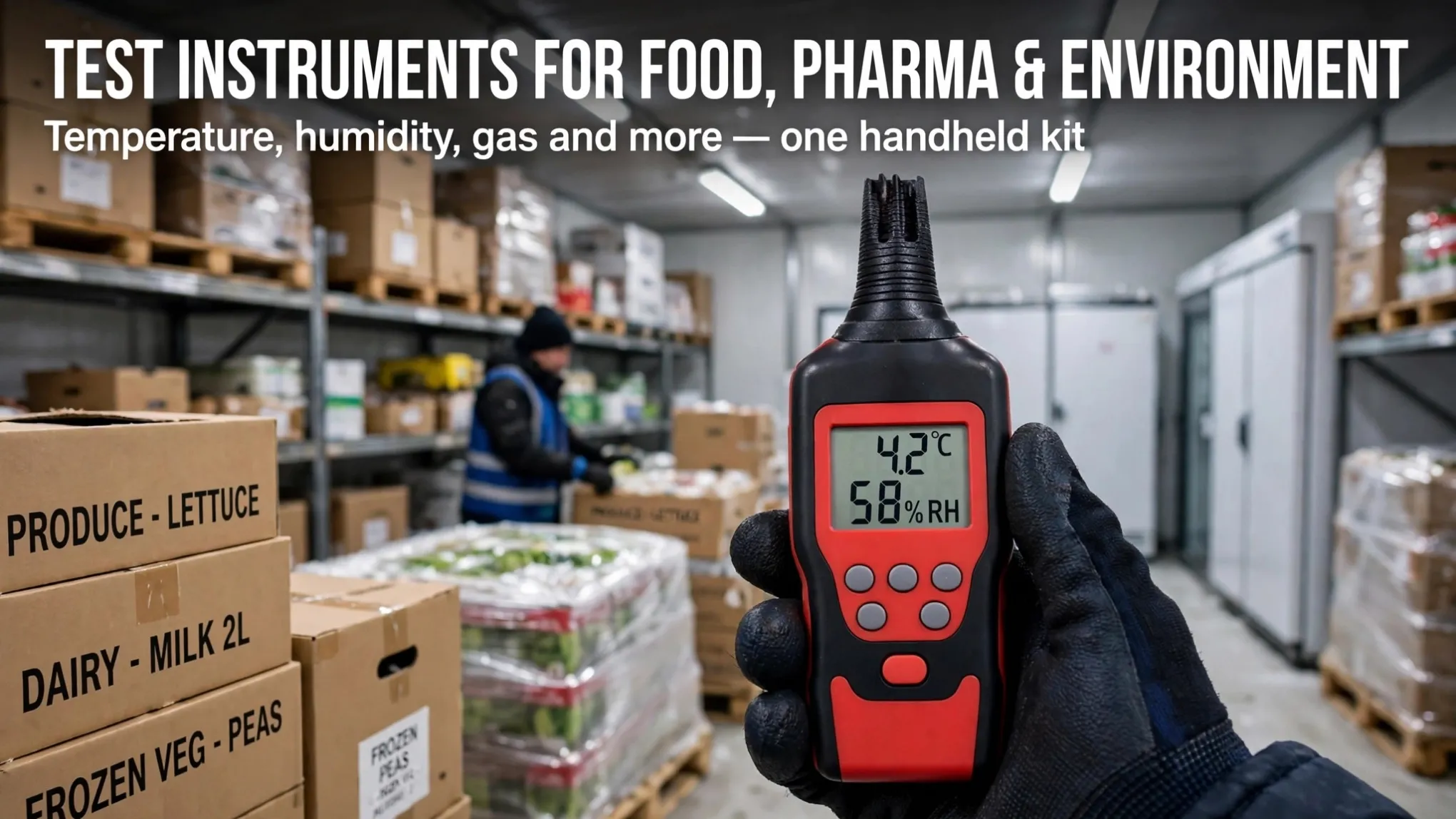
Food, pharmaceutical and environmental buyers rarely shop for test instruments the way a telecom engineer does. They are proving that a room, a product or a workplace stayed inside its limits — and that the proof will still stand up at an audit six months later. That is why the handheld kit looks so similar across all three: thermometers, thermo-hygrometers, pressure gauges, gas detectors, moisture meters, sound level meters and lux meters. What differs is what each reading has to prove.
Food: temperature, moisture and air, measured where the product is
Food testing guides start with the laboratory: chromatography, PCR pathogen detection and titrators. But much of daily food work happens outside the lab. Temperature is the first line of defence: cold-chain checks, cooking and cooling verification, and storage-room spot checks all come down to a probe in the right place. A K-type contact thermometer covers the wide span food work needs. The catalogue model 6802II, for example, measures −200 to 1370 °C with 0.1 °C resolution and an accuracy of 0.1% ±0.4° excluding probe error. Use the wrong probe and two people get two different readings on the same product.
Moisture decides shelf life: grain, powder and baked goods are bought and stored against a moisture limit, and a handheld meter gives a fast field reading before a sample reaches the lab. A meter such as the MC-7825P covers 0–80% with corrections for up to 150 species and a USB/RS-232 output — but the reading is only useful if the instrument is set for the material being measured.
Humidity and gas complete the picture. A handheld thermo-hygrometer such as the HT618 (−20 to 60 °C, ±0.5 °C accuracy, three AAA batteries) is the usual tool for a quick room check, while gas detectors cover carbon dioxide build-up in a cold store, oxygen deficiency in a tank or silo, and refrigerant leaks. The gas question always comes first — which gases, from which source — because no detector covers everything.
Pharma: cleanroom checks where the reading is the record
Pharmaceutical cleanrooms run on a different logic. Under EU GMP Annex 1, Grade A areas expect continuous particle monitoring, critical pressure differences are continuously monitored and recorded, and temperature and humidity are checked against their qualified ranges. FDA 21 CFR Part 11 and ISO 14644 say the same thing: the environment is part of the product's quality record.
Handheld instruments do not replace that fixed system. They do three jobs around it: commissioning checks, routine spot checks, and investigating the unexpected. For temperature and humidity, the spot-check instrument must be good enough to challenge the fixed system, so accuracy, a current calibration certificate and a clear audit trail matter more than a low price. A handheld manometer such as the GM510 (±10 kPa, ±0.3% of full scale, 0.5-second response) verifies a room-to-room pressure cascade, and an anemometer such as the GM8901 (0–45 m/s) checks that a diffuser or fume cupboard is actually moving the air it should — a reading no wall display can give.
One honest boundary: particle counting is a separate instrument class. A thermo-hygrometer or a manometer cannot tell you a particle count, and no supplier should suggest otherwise. If a programme needs particle data, it needs a particle counter, with its own calibration and sampling plan under ISO 14644.
Environmental and field work: gas, noise, light and air
Outside the factory, the same instruments answer a different question: is this workplace safe right now? Gas detection leads, because the failure mode is the most serious. A combustible-gas detector such as the WT8801 (0–100% LEL) is the tool for a confined-space entry check or a leak survey, but it is only as trustworthy as its last bump test: a daily bump test before use and a full calibration on the manufacturer's schedule are what separate a detector that protects people from one that only looks as if it does. A detector that reads zero in clean air proves nothing about whether it will respond to gas.
Noise and light are the two measurements buyers most often get wrong. A sound level meter must measure in dBA — the scale that matches how the human ear hears — and, for environmental work, in dBC as well. The GM1356 covers 30–130 dBA and 30–130 dBC at ±1.5 dB, with a USB interface and storage for 4,700 readings. For light, a lux meter such as the KT-600 (0–200,000 lux, 32,000 readings of memory, a detachable sensor on a 1-metre lead) lets the sensor sit on the work surface while the operator stands out of the light path — removing one of the largest sources of error in lux measurement, the operator's own shadow.
What to check before you buy
The specification sheet is the starting point, not the decision. Check range against the real conditions, accuracy with the conditions it was quoted at, data logging and output, calibration support, battery type and housing rating, and sensor life and replacement cost.
Ask for a sample unit and run it against the instrument you already use, in the real location, on the real product. A probe that reads correctly in a water bath may read differently on a frozen surface. Before ordering, also ask what calibration certificate is supplied and whether it is traceable, how often the manufacturer recommends calibration, what OEM customisation is possible (logo, packaging, manual, barcode) and the minimum order quantity, and what the warranty covers and who handles a claim in your country. A supplier that answers with documents rather than assurances is usually one whose instruments will survive an audit.
Frequently Asked Questions
What equipment is used for food testing?
Laboratory analysis uses chromatography, PCR pathogen detection, titrators and refractometers. Field work uses handheld instruments: thermometers, moisture meters, thermo-hygrometers and gas detectors.
What does cleanroom environmental monitoring measure?
Under EU GMP Annex 1, a programme covers total particles, temperature, relative humidity and differential pressure, plus viable-particle monitoring by sampling. Fixed sensors monitor continuously; handheld instruments handle spot checks, commissioning and investigations.
Can a handheld instrument replace a fixed monitoring system?
No. A fixed system records continuously and alarms the moment a limit is crossed; a handheld instrument takes a reading at one moment. Handheld instruments complement the fixed system — they do not replace it.
Do handheld gas detectors need regular calibration?
Yes. Gas sensors drift and can be poisoned by silicones, lead or sulphur compounds, leaving a detector reading zero in real gas. A daily bump test and a full calibration on the manufacturer's schedule are standard practice.
How do I choose a lux meter or a sound level meter?
Match the instrument to the standard the reading will be judged against. For noise, check the meter covers the required weighting (dBA, and dBC where needed) and range. For light, check the range, accuracy, and whether the sensor can sit on the work surface away from your shadow.
Looking for handheld test instruments for food, pharma or environmental work? Browse the range at zydhardware.com, or contact Shenzhen Zhanyueda Technology Co., Ltd. for specifications and samples.