
What Measuring Instruments Does a Repair Shop Need?
Setting up a repair shop? Which instrument to buy first — multimeter, clamp meter or insulation tester — what each covers, and the order that wastes least.
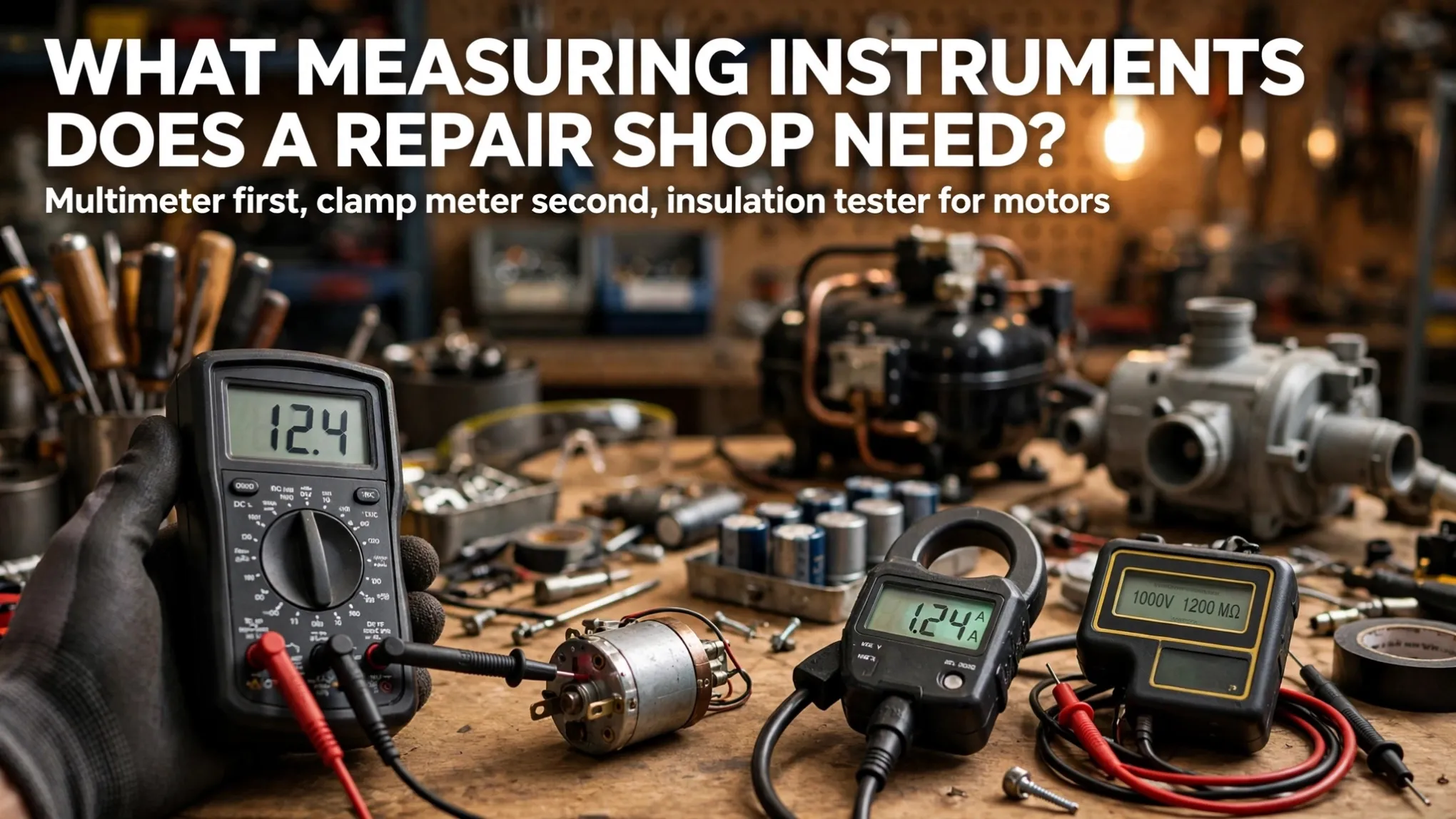
What Measuring Instruments Does a Repair Shop Need?
A repair shop that opens with the wrong instruments wastes money twice: on tools that sit unused, and on jobs it has to turn away. Three instruments cover nearly all electrical repair work — a digital multimeter, a clamp meter and an insulation tester — but the buying order matters. Buy the multimeter first: it answers the most questions on the most jobs. Add the clamp meter second, when live-current checks become a daily task. Add the insulation tester third, when motors and cables become regular work.
The Short Answer: Buy in This Order
1. Digital multimeter — first. Voltage, resistance, continuity, and often capacitance and temperature — the checks behind almost every job. One repair-shop guide puts it plainly: a True RMS multimeter proves more on a typical call than any other single instrument.
2. Clamp meter — second. It measures current in a live circuit without breaking it, so you can check a motor or compressor against its nameplate while it runs. Buy it when current checks become routine.
3. Insulation tester — third. It applies a high DC test voltage and measures leakage through insulation, which neither of the other two can do. Buy it when motors, pumps and cables become regular work.
What Each Tool Does — and Which Jobs It Covers
Tool | What it measures | Typical repair-shop jobs |
|---|---|---|
Digital multimeter | Voltage, resistance, continuity, capacitance | Dead appliance, blown fuse, open element, faulty thermostat |
Clamp meter | Live current without breaking the circuit | Amp draw vs nameplate, unbalanced phases, overload, locked rotor |
Insulation tester | Insulation resistance in megohms | Windings to frame, damp cables, rewind-or-replace call, post-repair check |
Walk One Job Through All Three Tools
A pump motor that trips its overload twice a shift shows how the three work together. First the multimeter: measure supply voltage phase to phase at the starter — in one field case the readings were 478 V, 480 V and 461 V, so the supply itself was unbalanced on one leg. Then the clamp meter: measure running current on each phase — the same case showed 11.8 A, 12.1 A and 15.6 A on a motor rated 12 A, one phase high, so the problem was not simply an overloaded pump. Finally the insulation tester: with the motor isolated, test winding to frame. A low or falling reading means the insulation has broken down from heat, moisture or age, and the motor needs rewinding or replacing rather than another breaker reset. Each step rules something out; skipping one means guessing.
What to Look for in Each One
Multimeter: True RMS, so it reads distorted waveforms from inverter drives and switching supplies correctly — an averaging meter can read far low on those loads. A safety rating of at least CAT III for distribution and panel work, a capacitance function for run capacitors, a loud continuity beeper, and test leads rated as a system with the meter.
Clamp meter: AC/DC or AC-only — an AC-only clamp reads zero on a DC bus, the most common wrong purchase for shops that touch batteries, electric vehicles or DC drives. Low-current resolution matters for control circuits, the jaws must close fully around a single conductor in your tightest panel, plus True RMS.
Insulation tester: selectable test voltages — commonly 250 V, 500 V and 1000 V — matched to the equipment, noting that 500 V is the minimum commonly cited for 230 V and 400 V installations. A resistance range high enough to show healthy insulation and fine enough to track deterioration, plus live-circuit warning and automatic discharge.
The Mistakes That Cost Repair Shops Money
Buying the clamp meter first. A clamp cannot do probe work — voltage at a socket, continuity of a fuse, resistance of a heating element. The multimeter comes first; the clamp waits until live-current checks are routine.
Buying an AC-only clamp for DC work. It reads zero on a DC circuit, which looks exactly like a dead circuit.
Trusting a multimeter's resistance range for insulation. Its test voltage is far too low to find the fault that matters. Only an insulation tester applies the hundreds of volts needed to reveal leakage.
Ignoring the safety rating. The category rating printed on the meter matters more than any feature: it is what stands between the technician and a panel fault. US safety regulators have recalled tens of thousands of clamp meters — about 52,000 units in 2009 and about 1,700 in 2017 — because the meters could show a wrong voltage reading and make the operator believe a live circuit was dead.
Try Before You Buy in Bulk
Before committing to volume, put samples through real work: check a live motor against its nameplate, test continuity on a familiar panel, try it with gloves, in low light, and confirm the box contents — leads, batteries, a case, a readable manual. Ask how calibration and after-sales support work, and whether spare leads are available. Private-label buyers should confirm logo, packaging, manual language and barcodes early; a supplier experienced in OEM and ODM work can confirm what can be customised and what must stay standard.
Frequently Asked Questions
What is the first measuring instrument a repair shop should buy?
A digital multimeter. It covers voltage, resistance and continuity — the checks behind most repair jobs — and technicians name it the tool that proves most on a typical call. Add the others as the work demands them.
Do I need a clamp meter if I already have a multimeter?
Not at first. A multimeter can measure current, but only by breaking the circuit and wiring the meter in series. A clamp meter becomes worth it when you regularly need live current readings — motor amp draw, compressor load, unbalanced phases — without disconnecting anything.
Can my multimeter test motor insulation?
No, not reliably. Its resistance range uses only a few volts, far too low to stress insulation. An insulation tester applies a high DC test voltage and reads leakage in megohms — the only honest answer to whether a winding is breaking down.
Do I need an insulation tester for appliance repair?
It depends on the work. For general appliance repair it can wait; for motor, pump and compressor work it is essential — insulation breakdown from heat and moisture is one of the most common motor failures, and only this tester finds it before burnout.
Should I buy an AC-only or an AC/DC clamp meter?
If you only work on mains-powered AC equipment, AC-only is enough. But if you touch batteries, solar, electric vehicles or DC drives, you need AC/DC: an AC-only clamp reads zero on a DC circuit — which looks exactly like a dead circuit.
A repair shop does not need every instrument on day one — it needs the right one first. Start with a capable multimeter, add a clamp meter when live-current checks become routine, and add an insulation tester when motors and cables become regular work.
Setting up a repair shop or building a test-instrument range for your market? Visit zydhardware.com to see our multimeter, clamp meter and insulation tester ranges — or contact us for OEM and bulk pricing.