
What Test Instruments Does a Data Center Electrician Need?
A data center electrician needs a True RMS multimeter, clamp meter, insulation and earth testers, thermal camera, battery tester and phase rotation tester.
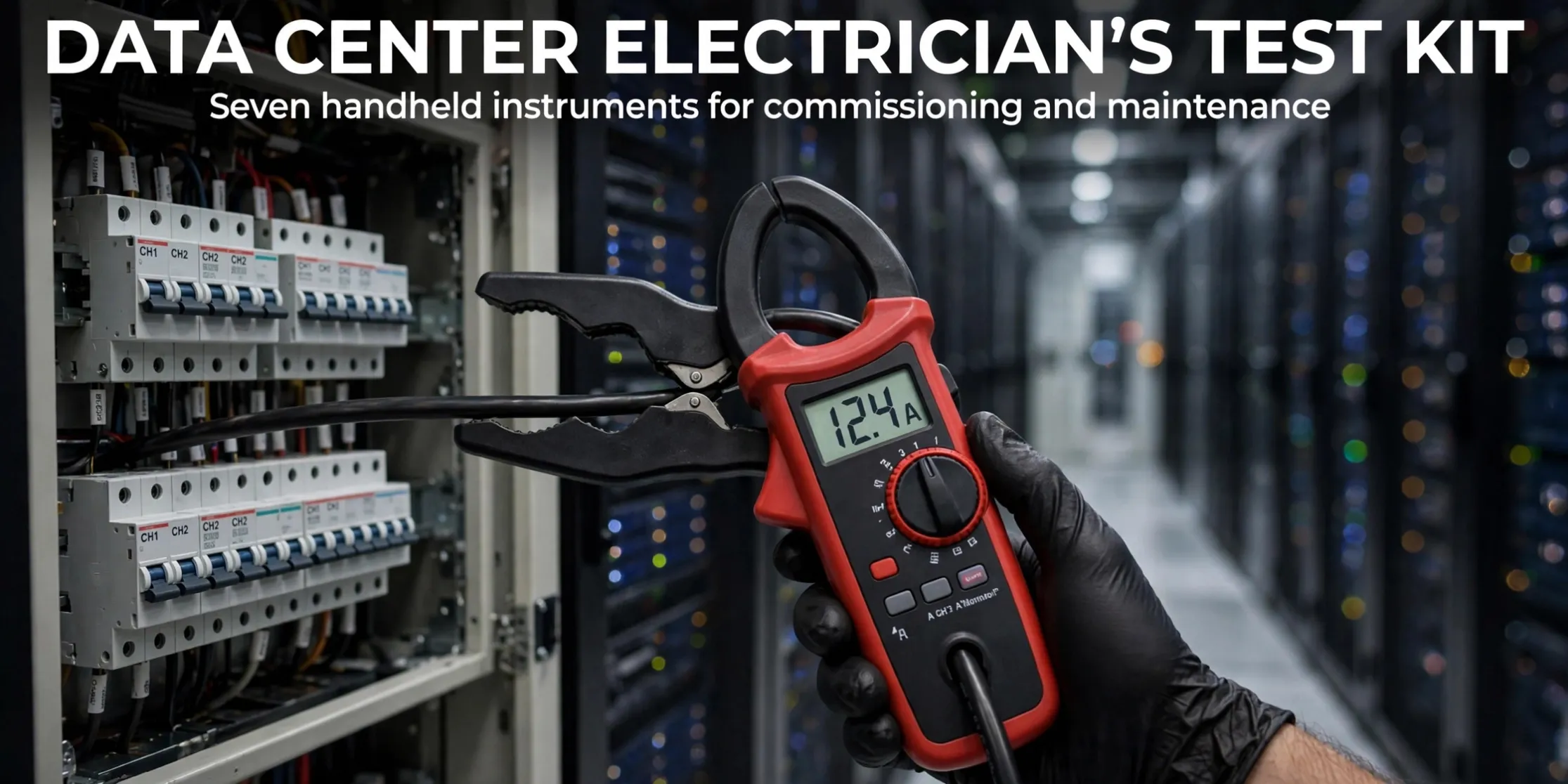
The Short Answer
A data center electrician needs seven handheld instruments: a True RMS digital multimeter, an AC/DC clamp meter, an insulation resistance tester, an earth ground tester, a thermal imaging camera, a battery tester for UPS strings, and a phase rotation tester. Power quality analysers, load banks and relay test sets are usually specialist or rented equipment. The seven tools below cover commissioning and maintenance. Demand is growing: Fortive's Q3 2026 call reported growth for Fluke in data center construction and maintenance.
Why a Data Center Is Harder to Test
Three things make data center electrical work different. First, the loads are almost entirely non-linear: servers, UPS systems and power supplies draw current in pulses, not smooth sine waves. An average-responding meter can read 10–40% low on this waveform, so True RMS is not optional. Second, redundancy changes how you test: a second power path stays live so one path can be maintained without an outage. Use the right safety category — CAT III for distribution panels, CAT IV at the service entrance. Third, the cost of being wrong is downtime: commissioning proves the redundancy works; maintenance finds the failing cable or bad cell before it causes an outage.
The Core Kit
Instrument | What it checks |
|---|---|
True RMS digital multimeter | Voltage, continuity, control faults |
AC/DC clamp meter | Load current, phase balance, inrush |
Insulation resistance tester | Cable and winding insulation |
Earth ground tester | Grounding electrode resistance |
Thermal imaging camera | Hot spots in switchgear, PDUs |
Battery tester | UPS battery string health |
Phase rotation tester | Phase sequence, UPS and generators |
1. True RMS digital multimeter
The first tool out of the bag on every visit: voltage and continuity checks, and fault-finding on PDUs and rack power strips. What matters most is True RMS measurement and a safety rating that matches the test point. The ZT-219 (19,999 counts, True RMS, DC 1000 V / AC 750 V / 20 A) covers low-voltage distribution ranges.
2. AC/DC clamp meter
Load balancing across the three phases is a routine check, done without breaking the circuit. Clamp each phase at the PDU: a large imbalance wastes capacity and heats connections. Inrush capture helps when a UPS or cooling unit starts. The HT208A (5,999 counts, True RMS, AC 60/600/1000 A) covers branch and feeder currents. Clamp a single conductor only — a whole cable reads near zero.
3. Insulation resistance tester
Insulation testing catches a cable before it fails. Periodic testing trends deterioration, so a cable can be replaced before it fails. Test before first energisation to set a baseline, then on a schedule. The GM3125 (100/250/500/1000/2500 V; 0.01 MΩ to 200 GΩ) covers low-voltage cables and windings; match the test voltage to the equipment rating. Never connect an insulation tester to a live circuit.
4. Earth ground tester
The grounding system keeps fault currents and surges away from server electronics, so its resistance must be verified, not assumed. A three-pole fall-of-potential test checks a grounding electrode; a clamp-on tester checks a complete loop. The HT3202 (0–29.99 Ω, 0–200 V) suits routine checks. Dry soil reads higher than wet soil.
5. Thermal imaging camera
Loose terminals and overloaded breakers show up as heat before they fail. A thermal camera scans a switchboard in minutes and spots the hottest connection. The HT04D (160 × 120, −20 to 550 °C) is enough for panel checks. Shiny copper has very low emissivity, so a bare busbar reads far cooler than it is — compare a connection with the one next to it.
6. Battery tester
A UPS is only as reliable as its weakest cell — one bad cell can take the whole string down during a power dip. A conductance tester such as the AE300 estimates capacity and flags weak cells; a load tester such as the BT-100A/B applies a real load (100 A, 6 V/12 V) and checks voltage under load. Test every cell and record the results.
7. Phase rotation tester
Generators, UPS systems and cooling units are three-phase equipment, and the wrong sequence makes motors run backwards. A phase rotation tester such as the SM852B confirms the sequence before the equipment starts — a two-minute check. Use it at commissioning and after any reconnection. If it shows the wrong direction, swap any two phases and re-test.
Commissioning vs. Maintenance
During commissioning, the goal is proof: verify continuity, insulation and circuit protection before staged energisation, and set a baseline. Integrated systems testing proves the power and cooling chain responds correctly when utility power is lost. During maintenance, the goal is trend: deterioration only shows up if readings are recorded and compared.
How to Evaluate Instruments Before You Buy
Evaluate samples on the job, not only on the datasheet. Check the safety rating: confirm the CAT rating against the points where the instrument will be used. Test on a real waveform: measure a server power supply and compare the True RMS reading with a second instrument. Ask about calibration support and certificates. Ask about OEM and ODM options: if you buy in volume, ask about your logo, packaging and manual, and confirm the minimum order, lead time and warranty in writing. Total cost matters more than the lowest price.
Frequently Asked Questions
What test equipment is needed for data center commissioning?
A True RMS multimeter, a clamp meter, an insulation resistance tester, an earth ground tester, a thermal camera and a phase rotation tester. Load banks and power quality analysers cover the system-level tests and are usually rented.
How do you test a UPS battery in a data center?
Test every cell, not just the string as a whole. A conductance tester estimates capacity and flags weak cells; a load tester shows whether a cell holds voltage under a real load. Record each reading and compare it with the rest of the string and past visits.
Why does a data center need insulation resistance testing?
Insulation degrades silently, and a cable that fails in service can take down a whole power path. Periodic testing trends that deterioration, so a cable can be replaced during planned maintenance. Test before first energisation to set the baseline, then on a schedule.
What is the difference between commissioning testing and preventive maintenance testing?
Commissioning proves the installation is correct and creates the baseline readings. Maintenance repeats the same measurements on a schedule and compares them with that baseline, so gradual deterioration shows up before it becomes a failure.
Can a regular clamp meter measure data center loads?
Yes, for branch and feeder currents, as long as it is a True RMS meter and you clamp a single conductor. Average-responding meters can read low on harmonic-rich waveforms, and clamping a whole cable reads near zero.
Next Step
Equipping a data center team or sourcing instruments for a facility project? Start with the seven-tool kit above. For details and OEM/ODM options, contact us through www.zydhardware.com — tell us what you will measure, and we will help you match the model.