Oct 12, 2026Buying Guides
1500V DC Solar Multimeter: A Distributor’s Guide to Safety, Logging, and Batch QC
Learn how to source a 1500V DC solar multimeter by safety rating, accuracy, test leads, logging, current sensors and batch consistency.
For a distributor, a 1500V DC solar multimeter is not simply a conventional digital multimeter with a higher number printed on the range selector. It is a measurement system for work around long PV strings, combiner boxes, inverters, battery banks and other high-energy DC equipment. The meter, input protection, test leads, connectors, current sensor, firmware and documentation all have to match the intended application.
This distinction matters during sourcing. A sample may display 1500V DC, 60,000 counts and a clear trend graph, yet still leave unanswered questions about measurement category, terminal protection, lead ratings, sustained input limits or batch consistency. Those gaps create risk for importers, wholesalers and private-label brands long after the first sample has passed a basic bench test.
Quick answer: what should a buyer verify first?
Start with the intended electrical environment, not the display resolution. Confirm the highest working voltage, where technicians will connect the meter, the relevant measurement category, and whether every supplied accessory is rated for the same job. Then compare DC voltage accuracy, current-measurement method, logging behavior, environmental limits and production controls.
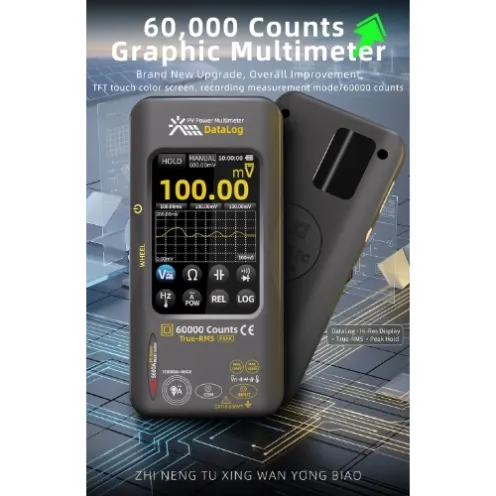
A credible 1500V DC sourcing file should contain model-matched specifications and safety documents for the meter and its leads. It should also define the exact configuration that will be produced. The public listing for the ZYD S600A graphical recording multimeter describes a 60,000-count touchscreen instrument for PV-related work with data recording, high-voltage DC measurement and a flexible current-sensor option. Buyers should still confirm every range, rating and accessory against the approved quotation, manual and test reports.
Why solar PV changes the multimeter specification
Utility and commercial PV systems can use long series strings that produce high DC voltage whenever light reaches the modules. DC arcs do not pass through a natural zero crossing in the same way as AC waveforms, and available energy can remain significant even after some equipment is switched off. A meter selected for building maintenance may therefore be unsuitable for the DC side of a solar plant.
The application also changes the practical workflow. Technicians may work outdoors, in bright sunlight, at multiple combiner boxes, or on large sites where readings must be compared over time. A useful PV meter may need:
- a documented DC voltage range that covers the system;
- a measurement category suitable for the connection point;
- matching high-voltage leads, probes and PV connector adaptors;
- clear polarity indication and a display readable in sunlight;
- current measurement appropriate to the expected conductor and current;
- logging or trend capture for intermittent behavior;
- environmental limits compatible with field work;
- repeatable performance across samples and production batches.
1500V range does not automatically mean CAT III 1500V
Maximum displayed voltage and measurement category describe different things. The voltage range tells the buyer what the instrument is designed to measure under specified conditions. A CAT rating describes the transient environment and the installation location for which the product has been evaluated.
For example, a meter that can display 1500V DC is not automatically suitable for every 1500V PV connection point. Buyers should request the exact category and voltage marking, the applicable test standard, the laboratory or conformity evidence, and any limitations stated in the manual. IEC 61010-2-033 addresses hand-held multimeters capable of measuring mains voltage, while IEC 61010-031 covers hand-held probe assemblies. Current clamps and flexible current sensors have their own relevant requirements.
If category terminology is unfamiliar, review CAT III vs CAT IV multimeters before comparing offers. The correct question is not “Does it say 1500V?” but “Is the complete supplied measurement system documented for the exact circuit and connection point?”
Specification | What it tells the buyer | What it does not prove |
|---|---|---|
1500V DC range | The meter can display DC voltage up to a stated limit under defined conditions | Measurement category, transient withstand or accessory suitability |
CAT marking | The intended transient environment and installation level at a stated voltage | Accuracy, resolution or suitability for every PV task |
60,000 counts | Potential display granularity before a range change | Basic accuracy, stability or calibration quality |
True RMS | AC measurement method for nonsinusoidal waveforms within stated limits | DC safety performance or bandwidth outside the specification |
Data logging | Ability to capture readings over time | Correct time base, sample interval, memory integrity or export compatibility |
Treat the meter, leads and connectors as one safety system
A high-voltage meter can be undermined by lower-rated leads, probe caps, clips or PV adaptors. Buyers should freeze the supplied accessory list during sample approval and require clear, durable markings on every relevant part. Do not accept a report for one lead set while production uses another.
Test-lead details to inspect
- voltage and category markings on the lead and probe body;
- finger guards, probe-tip exposure and removable protective caps;
- insulation flexibility after low-temperature storage;
- strain relief at both probe and plug ends;
- connector fit, contact resistance and pull strength;
- wire length, material and resistance consistency;
- compatibility with the meter’s shrouded terminals;
- traceability between the accessory, manual and test documentation.
IEC 61010-031 specifically addresses hand-held and hand-manipulated probe assemblies. For a distributor, that means the lead set is not packaging filler. It is a controlled component that needs its own drawings, markings, inspection criteria and change control.
Accuracy, resolution and counts must be separated
A 60,000-count display can show small changes, but it does not guarantee that those changes are accurate. Buyers should compare the full accuracy expression for each range, including the percentage of reading, digit term, temperature window and calibration interval. Review how to compare multimeter specifications if supplier data sheets use different formats.
For PV work, check the ranges that technicians will actually use. A low DC-voltage range may matter for sensors and control circuits, while the highest DC range matters for strings and combiner inputs. One headline accuracy value is rarely enough.
Questions for the specification sheet
- What are the DC voltage ranges and resolution on each range?
- What is the stated accuracy, digit term and temperature condition?
- Is the highest-voltage range maintained continuously or subject to a time limit?
- What input impedance is used on each range?
- How quickly does the reading settle after a range change?
- Is there a low-pass or high-frequency rejection mode for inverter environments?
- What is the overload recovery behavior?
Current measurement: match the sensor to the job
Solar service can involve string current, inverter output current and larger conductors in tightly packed cabinets. A flexible current probe can improve access, but the probe type and bandwidth must match the application. An AC-only flexible probe does not measure DC string current. A buyer should never assume that a high current number applies to both AC and DC.
For every supplied or optional sensor, confirm:
- AC, DC or AC/DC capability;
- measurement range and resolution;
- accuracy by range and frequency;
- conductor capacity and minimum bend requirements;
- sensor output ratio and meter input mode;
- zeroing procedure for DC sensors;
- measurement category and maximum working voltage;
- included accessories and production-batch identification.
Logging and trend graphs should solve a real field problem
Graphical recording is useful when a fault is intermittent or when a technician needs to compare changing voltage, current or power behavior. It can also support commissioning records and incoming QC. But a color trend line is only valuable if the underlying data are trustworthy.
During sample approval, verify the selectable sampling intervals, total recording duration, time and date retention, memory-full behavior, minimum and maximum capture, export format and file naming. Power-cycle the meter during a recording and confirm what is preserved. Compare the exported data with a stable reference input.
For troubleshooting context, see how multimeters and oscilloscopes capture intermittent electrical faults. A logging meter is suitable for slower changes and long-duration trends; it is not a substitute for an oscilloscope when waveform shape or brief transients must be resolved.
A practical sample-approval workflow
1. Freeze the exact configuration
Record the model suffix, firmware version, meter color, battery, leads, probe caps, current sensor, case, charger or cable, manual and packaging. Photograph the approved sample and assign it a golden-sample number.
2. Review safety evidence before energized testing
Match the model name and hardware revision on reports to the sample. Check the stated standards, rating, laboratory, issue date and covered accessories. Any mismatch should be resolved before a technician connects the meter to a high-energy circuit.
3. Verify measurement performance on controlled sources
Use traceable reference equipment and safe laboratory procedures. Test representative points across the main ranges, including zero, mid-scale and near the upper operating region. Allow the specified warm-up time and record ambient conditions.
4. Exercise the user workflow
Check range selection, polarity indication, warning messages, display readability, touch response, screen lock, backlight, data hold, trend setup, file export and recovery after low battery. A feature that works only in ideal bench conditions may generate distributor returns.
5. Repeat across multiple units
One sample cannot prove batch consistency. Compare at least several independently selected units and retain the raw results. Look for spread, not just pass/fail. Wide variation can reveal component, calibration or assembly-control problems before a production order.
Incoming batch QC: 12 checks for distributors
Check | What to verify | Typical sourcing risk |
|---|---|---|
1. Identity | Model, suffix, firmware and serial format match approval | Uncontrolled configuration changes |
2. Markings | Voltage, category, terminals and warnings are durable and consistent | Incorrect or missing safety information |
3. Accessories | Lead set, caps, sensor, cable and case match the purchase order | Lower-rated substitutions |
4. Housing | No cracks, gaps, loose terminals or contamination | Assembly and insulation defects |
5. Display and touch | Uniform screen, reliable touch zones and readable outdoor mode | Usability complaints and dead zones |
6. DC voltage | Selected reference points on relevant ranges | Calibration drift or wrong range constants |
7. AC voltage | Accuracy at defined amplitudes and frequencies | True-RMS or bandwidth inconsistency |
8. Resistance/continuity | Accuracy and continuity response time | Slow or inconsistent field operation |
9. Current sensor | Correct type, ratio, zero and representative current points | AC/DC confusion or accessory mismatch |
10. Logging | Time base, interval, saved file and export integrity | Missing or unusable records |
11. Power system | Battery indication, charging behavior and low-battery recovery | Unexpected shutdown or corrupted files |
12. Documentation | Manual, declarations and report references match the shipped unit | Customs, liability and after-sales disputes |
The inspection sample size should reflect order value, defect history and market risk. Safety-critical mismatches normally require containment and investigation rather than simple statistical acceptance.
What to include in a solar multimeter RFQ
- intended PV system voltage and connection points;
- required measurement category and voltage;
- DC and AC voltage ranges, resolution and accuracy;
- required AC/DC current method and conductor size;
- True-RMS bandwidth and crest-factor conditions;
- logging interval, duration, memory and export format;
- display type, counts, graphing and touchscreen requirements;
- operating temperature, humidity, altitude and ingress protection;
- test-lead, probe-cap and PV adaptor specification;
- model-matched safety and EMC documentation;
- calibration process, golden sample and batch QC limits;
- OEM/private-label artwork, manual language and packaging tests.
Frequently asked questions
Can any 1000V multimeter be used on a 1500V PV system?
No. Never exceed a meter’s or accessory’s specified working limits. Select equipment documented for the actual voltage, measurement category and connection point, and follow the site’s electrical safety procedure.
Does 60,000 counts mean the meter is more accurate?
Not necessarily. Counts describe display resolution. Accuracy depends on the stated error specification, calibration, stability and test conditions.
Is a flexible current probe suitable for DC string current?
Only if the probe is specifically designed and documented for DC measurement. Many flexible probes are AC-only. Confirm the sensor type, range, output ratio and category rating.
Why is data logging useful for PV maintenance?
Logging can reveal slower intermittent changes, compare operating periods and support commissioning records. Buyers should verify timestamps, intervals, memory behavior and exported data rather than judging the graph alone.
Should test leads be included in batch inspection?
Yes. Leads, probes and adaptors are part of the measurement system. Their ratings, construction, markings and connection quality should match the approved sample and documentation.
What is the biggest procurement mistake with a 1500V DC meter?
The biggest mistake is approving the product from a headline range alone. The safer approach verifies application, category, input protection, accessories, accuracy, environmental limits and model-matched evidence as one package.
Build a PV meter program that distributors can support
A professional 1500V DC solar multimeter program needs more than an attractive screen and a long function list. It needs defensible safety documentation, matching accessories, stable measurement performance, usable records and repeatable production.
Explore the ZYD test and measurement catalog for distributor and private-label options. If you are evaluating a PV multimeter line, send ZYD your target system voltage, connection points, required current method, logging workflow, destination market and expected order quantity. The team can help confirm a model configuration, sample plan and batch-QC checklist before production.