
NOM Compliance for Handheld Test Instruments in Mexico
Buying test instruments for Mexico? Check NOM certification first: which NOM applies, what to verify on the certificate, and the red flags that stop shipments.
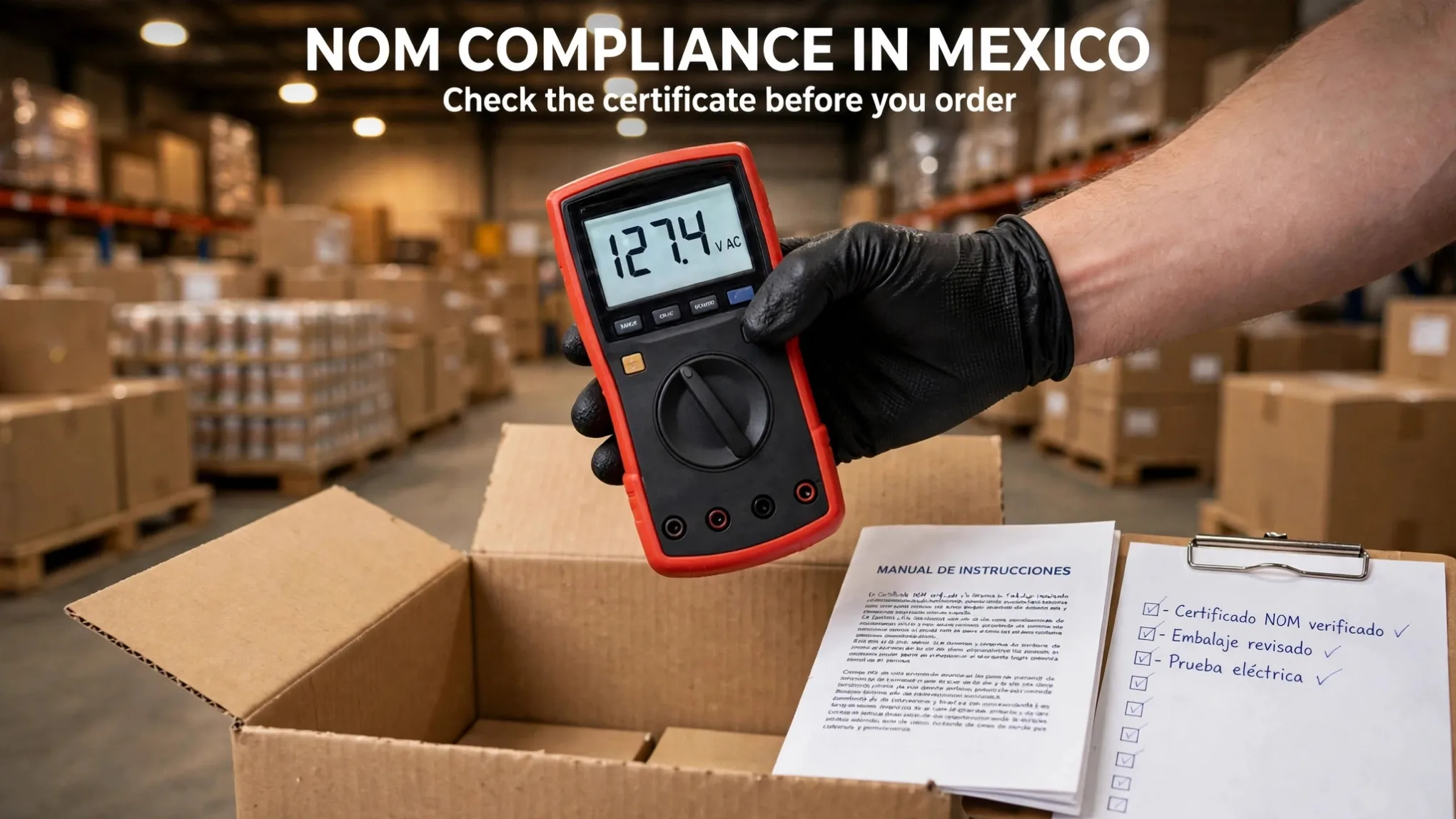
The Short Answer
If you buy handheld test instruments for Mexico, check NOM compliance before price, delivery time, or the order itself. NOM (Norma Oficial Mexicana) is Mexico's mandatory technical standard: electrical products generally need NOM safety certification to enter and sell legally, and customs can hold a shipment without valid proof.
The trap is that "NOM" means two different things: a product certificate, earned by testing in an accredited laboratory, and labelling — Spanish instructions, warnings, origin and importer details on the box. A labelling problem can be fixed by printing new labels. A missing certificate cannot be fixed at the border.
1. Two Different NOMs — Do Not Confuse Them
Mexico's NOM system covers more than 2,000 product categories, in two families.
Product NOMs judge the product itself, mainly electrical safety. The instrument must be tested by an ema-accredited laboratory and certified by a Ministry of Economy-approved body; ANCE and NYCE issue most certificates. A CB report or a UL listing does not substitute.
Commercial-information NOMs judge what the label and the manual say, not whether the product is safe. NOM-024 covers Spanish instructions, warnings and warranty information; NOM-050 covers labelling: product name, brand, model, origin, and importer name and address. These are real requirements, but a one-day fix, not a two-month project. When a supplier says "we have NOM," ask which one: a label is not a certificate.
2. Check the Tariff Line Before the Certificate
NOMs apply by tariff line, not to products "in general." Mexico's Ministry of Economy publishes Anexo 2.4.1, mapping tariff fractions to the NOMs that apply — a September 2026 revision added 36 entries. First step: classify correctly (HS/TIGIE code), then check which NOM that line flags.
A wrong classification gives you the wrong list of NOMs, and you find out at customs, when the pedimento (import declaration) is filed — the certificate must exist before it is paid.
The two standards most often cited are NOM-003-SCFI-2014 (electrical products up to 1,000 V) and NOM-001-SCFI-2018 (electronic products up to 480 V AC / 500 V DC, including battery-powered products up to 24 V). Which one applies depends on category and tariff line — ask ANCE or NYCE at planning time.
3. Five Things to Verify on the Certificate
Read the certificate the way a Mexican customs broker would:
1. The holder. A NOM certificate is issued to a Mexican company with a tax ID (RFC) — normally the distributor or importer of record. A foreign manufacturer cannot hold it directly.
2. The scope. The certificate covers specific models, listed by name. A certificate for a multimeter does not cover the clamp meter in the same shipment. Check that every model in your order appears on it.
3. The standard number. The certificate should name the NOM it certifies against — for example NOM-003-SCFI-2014 — and the issuing body. A document that only says "NOM approved" is not a certificate you can rely on.
4. The expiry date. NOM certificates are valid for one year, renewed annually after a product is sampled from the market and retested.
5. The mark on the product. The NOM mark must appear on the product and packaging, with origin, importer details and model — all in Spanish.
4. Check the Product and the Box
Certification is only half the job. Open the carton and check four things: the manual — in Spanish, with safety warnings and warranty terms; the label — product name, brand, model, origin, and importer name and address, all in Spanish; the ratings — voltage, frequency and power rating must match the certificate and the Mexican mains supply (127 V / 60 Hz); and the NOM mark — present on the body and packaging, legible, matching the certificate.
5. Six Red Flags When a Supplier Says "NOM Certified"
Most suppliers who claim NOM certification are telling the truth. The rest usually give themselves away:
- "We have CE and UL, so NOM is covered." It is not — foreign reports do not substitute.
- "The certificate is being processed." The goods cannot legally enter Mexico yet — the process takes two to six months.
- A certificate for a different model. If the model number on it does not match your order exactly, it does not cover your order.
- An expired certificate, sent without comment.
- No NOM mark on the sample. If the product carries no mark, the certificate may belong to a different production run or factory.
- "NOM is the importer's problem." Partly true — but if your product cannot pass the tests, no importer can fix that.
6. Plan the Calendar: Testing, Validity, Renewal
Certification guides put the full process — testing, then certification — at two to six months. Start before you need the stock.
Then plan for the renewal. A certificate lasts one year, and renewal means sampling a product from the market and retesting it. So the certified model must stay unchanged — same design, factory and key components. If the factory changes anything, tell the certification body first: a quiet change that voids the certificate is discovered when the next shipment is already at the port.
The rules have also tightened: a reformed Customs Law took effect on 1 January 2026, and missing or invalid NOM documentation is a leading cause of shipments being held at Mexican customs. Get it right before the first order.
7. Questions to Ask Your Supplier Before You Order
Send these in writing and keep the answers with the order file:
- Which NOM applies to each model, and which certification body confirmed it?
- Who holds the certificate, and is it valid for the full delivery period?
- Can you send a copy showing the model names, the standard number, the issuing body and the expiry date?
- Is the NOM mark on the product and packaging? Can you send a photo of it?
- Are the manual, warranty and box labelling already in Mexican Spanish?
- Has anything changed since the certificate was issued?
- If a model is not yet certified, what is the timeline and who pays?
If the supplier cannot answer the first three, do not order yet.
Related reading
Frequently Asked Questions
Do multimeters need NOM certification in Mexico?
Generally yes. Confirm the exact NOM with ANCE or NYCE first.
Can I use a CE or UL certificate instead of NOM?
No. A CB report or a UL listing does not substitute for a NOM certificate.
Who can hold a NOM certificate?
Only a Mexican company with a tax ID (RFC), normally the distributor or importer of record.
How long does NOM certification take?
Two to six months from testing to issuance, per certification guides.
What happens without valid NOM documents?
Customs can hold or seize the goods.
Planning to buy handheld test instruments for Mexico? Start with the certificate, not the price list. Visit zydhardware.com, tell us your target models and quantities, and we will confirm availability, delivery time and documents. Shenzhen Zhanyueda Technology Co., Ltd. supports OEM/ODM orders (logo, packaging, manual, barcode) and works with your distributor on market documentation.